Introduction
You didn’t invest millions in new packaging equipment just to “ramp up eventually.” Yet that’s exactly what happens in most CPG facilities.
The line gets installed. The ribbon gets cut. The OEM team leaves. And then performance drops with unplanned downtime, quality issues, frustrated operators, missed throughput targets, and an OEE (Overall Equipment Effectiveness) curve that looks more like a slow hill than a vertical line.
If your startup plan quietly assumes a 3–6 month performance dip, you’re not planning for vertical startup — you’re planning for failure.
At the same time, there are documented cases of CPG manufacturers hitting 85%+ OEE in month one and reaching steady-state performance almost immediately. So what separates those companies from the rest?
The difference isn’t luck. It’s how they treat FAT (Factory Acceptance Testing), SAT (Site Acceptance Testing), training, and cross-functional alignment not as isolated milestones, but as one continuous system.
In this article, you’ll learn:
What Is Vertical Startup in CPG Packaging?
Vertical startup means moving from installation directly to sustained, target-rate production with minimal or no performance dip.
Instead of this scenario:

Installation → Weeks of downtime → Slow ramp → Quality issues → Gradual OEE improvement
You get this:

Installation → Immediate target-rate production → Stable OEE
It’s a step function, not a slope.
There’s no universal numerical definition of “vertical,” but best-in-class examples show the following values:
For context, average manufacturing OEE across industries often sits around 60–70%, with 85% widely cited as “world-class.”
But here’s the nuance — OEE benchmarks only matter if calculated consistently. Changeover inclusion, micro-stops, and planned production time definitions dramatically affect reported numbers.
Ultimately, vertical startup isn’t about chasing a vanity metric. Instead, it’s about eliminating the predictable startup dip most companies accept as normal.
Why Most CPG Packaging Startups Fail (5 Reasons)
The uncomfortable truth? Most failures are designed into the project long before installation, and here are their most common root causes…
1. The FAT Is Treated Like a Formality
The single strongest leading indicator of startup success is the quality of the Factory Acceptance Test (FAT).
Yet many companies:
The purpose of an FAT is simple: Verify the equipment meets agreed specifications before it leaves the OEM facility (when problems are cheapest to fix).
Confusion happens when teams try to simulate site conditions at the OEM. That’s not the FAT’s job. That’s SAT’s job.
In the end, a weak FAT almost guarantees a painful startup.
2. FAT and SAT Are Treated as Separate Events
The Site Acceptance Test (SAT) verifies performance in your actual production environment, encompassing factors such as real utilities, temperature, humidity, and upstream and downstream integration.
But in many projects:
Best-in-class SAT outcomes are defined by minimal OEE drop when the vendor departs. If performance collapses the day support leaves, that’s not a training problem. That’s a system problem.
FAT and SAT must be designed together — not sequentially.
3. Training Is Compressed Into the Startup Window
Most companies treat training as a two-day crash course before hand-off.
Best-in-class companies start training at the FAT where operators and maintenance teams can achieve these critical steps:
PMMI research consistently shows that early and continuous training is a differentiator.
Vertical startup is impossible if your operators are learning under live production pressure. Training should extend 3–6 months beyond startup — not end at it.
4. Cross-Functional Teams Are Brought in Too Late
Vertical startup is not an engineering problem. It’s a cross-functional coordination problem.
Operations, maintenance, quality, supply chain, and IT must be involved from RFP through commissioning. When maintenance first sees the machine at installation, or quality first reviews specs during SAT, delays are inevitable.
Ambiguity about ownership — especially during the FAT-to-SAT-to-startup transition — is one of the most common failure modes.
5. Organizations “Expect the Dip”
This may be the most damaging mindset of all. Many project plans quietly build in:
In a sense, the dip becomes institutionalized. But research shows the dip is avoidable when:
When you plan for the dip, you get the dip.
How to Achieve Vertical Startup Instead (6 Steps)
Avoiding failure isn’t enough. You need a deliberate system designed to produce a vertical outcome. Here’s what that looks like in six straightforward steps…
1. Start FAT Planning at the RFQ Stage
Your FAT protocol should be submitted with your RFQ — not drafted later. In your RFQ, be sure to specify:
When expectations are vague, disputes are inevitable. These specifications help make acceptance criteria contractual.
2. Use Actual Production Materials at Rate
Testing with substitute materials creates false confidence. Instead, use actual films, corrugate, adhesives, inks — everything.
You can supplement with wildcard testing for flexibility, but production materials must anchor validation.
3. Conduct a Pre-FAT Before the Full FAT
For complex lines, schedule a short pre-test 2–3 weeks before the official FAT. This prevents expensive travel for a machine that isn’t ready.
It’s a small discipline that prevents major waste.
4. Design FAT and SAT as One Continuous Process
Your lifecycle should look like this:
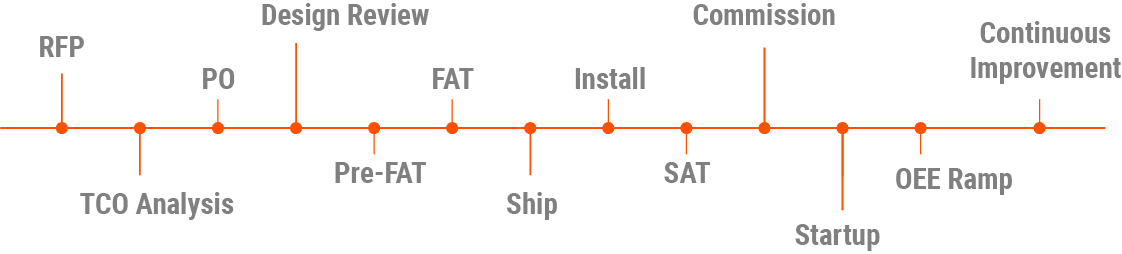
Not this:

To achieve a healthy lifecycle, the transition between OEM-supported operation and independent production must have:
5. Measure What Matters During Startup
For accurate measuring, define these values upfront:
Without predefined metrics, “good enough” becomes the default, and vertical startup becomes impossible to evaluate.
6. Build OEM Relationships Beyond the Contract
Vertical startup is relational, not transactional.
Contracts should define:
But strong working relationships matter just as much as written terms.
When startups fail, finger-pointing follows. When startups succeed, it was collaboration that led the way.
The Critical Insight
Vertical startup is not an event. It is the outcome of everything that came before it.
The quality of your FAT predicts your startup. The rigor of your SAT protects your ramp.
The depth of your training determines your stability. The clarity of your ownership defines your speed.
Most CPG packaging startups fail because the system that produces success was never built.
Final Thoughts: From Dip to Discipline
If you’ve ever endured a painful startup, you know the cost in overtime, morale, lost production, and credibility.
Historically, many organizations accepted that pain as inevitable. But now you can make decisions knowing that vertical startup is a design choice.
If your next capital project is approaching, your next step is to audit your FAT and SAT process against the questions in this article — before the PO is signed. Because once the machine ships, the outcome is largely locked in.
Remember, the best startups don’t happen at installation. They happen months earlier — on paper.