Introduction
Your filler is fast. Your primary packaging keeps up. And then you hit the end-of-line wall: case packing slows down, changeovers chew up your schedule, staffing gaps crater your second shift, and palletizing becomes the bottleneck nobody budgeted to fix.
If you’re dealing with any of that, you’ve probably considered an upgrade to your secondary packaging automation. More specifically, there’s a good chance you’ve investigated robotics-enabled automation and asked yourself the question:
“Is a robot a good fit here—or is this a problem we can solve cheaper another way?”
We work with manufacturers who are under pressure from SKU growth, labor volatility, retailer-driven pack formats, and ergonomic risk. In that environment, robotics can be the best-fit tool in secondary packaging—but it’s also easy to overspend, under-support the cell, or automate the wrong constraint.
In this article, you’ll learn:
What “Secondary Packaging” Includes (And Why It Becomes The Bottleneck)
Secondary packaging is the packaging of a product that’s already in its primary package— such as cases, trays, retail-ready/display-ready cartons, shrink bundles, multipacks, and variety packs.
This is where complexity piles up:
Secondary packaging is often the first place your line stops being an equipment problem and becomes a variability problem. Variability is exactly where robots can shine—when the rest of the system is ready for them.
When Robotics in Secondary Packaging Is Worth It
Robotics tends to be worth it when flexibility and consistency are more valuable than raw top speed. Here are the most common “yes” cases.
If you’re changing case sizes, pack patterns, counts, or configurations multiple times per shift, every changeover is a recurring cost event.
A robotic cell can often switch formats through recipes (and sometimes automated tool changes) instead of lengthy mechanical change parts and adjustments.
Here’s how to sanity-check this fast. Track two weeks of changeovers that include:
If your line spends hours per week “not producing,” robotics often becomes a throughput stability investment, not just a labor play.
Bags, pouches, flow-wrap, and lightweight flexible packaging often behave unpredictably. Fixed mechanical systems can run—but they frequently require derating speed, manual intervention, or frequent jam clears.
A robotic cell can often switch formats through recipes (and sometimes automated tool changes) instead of lengthy mechanical change parts and adjustments.
Vision-guided pick-and-place (especially in top-load applications) can adapt to random orientation and timing issues better than fixed mechanical motion.
What to measure: Jam frequency, manual touch time, damage/mispacks, and how far below rated speed you’re forced to run.
If output depends on who shows up, you’re paying for instability:
Robots don’t eliminate people—but they can reduce dependence on the hardest-to-staff, highest-turnover manual positions and stabilize output shift to shift.
What to measure: Unfilled positions, overtime hours tied to understaffing, and production losses attributable to headcount gaps.
Manual case handling and palletizing are frequent culprits for recordables and attrition.
Even if your ROI model starts as “labor savings,” the more honest story is often this: Reduced injuries → fewer disruptions → more reliable output.
What to measure: OSHA 300 data by area, restricted-duty days, turnover by role, and workers’ comp claim frequency/cost trends.
Mixed packs and retailer-specific formats add complexity that can overwhelm purpose-built machines or force manual collation.
If you’re turning down business, outsourcing to co-packers, or adding manual labor just to build assortments, robotics can become a capacity and capability unlock—not just an efficiency upgrade.
What to measure: Lost sales opportunities, co-packer spend, speed derates on mixed packs, and incremental labor needed to meet format demands.
When Robotics Is Not Worth It
This is where teams save real money—because the most expensive robot is the one you buy for the wrong job.
If your format rarely changes and your volumes are high, traditional mechanical case packers can be extremely fast and cost-effective.
Caveat: You CAN choose robots for reasons other than flexibility … For example, if you value fewer parts/components or simplified theory of operation, robots might still prove the most value.
Robots don’t magically cure chaos upstream. If spacing, orientation, timing, or accumulation are inconsistent, performance will suffer.
In many plants, the real project is “fix infeed and flow,” and the robot is the final step—not the first.
Heavy, fragile, sticky, deformable, or unusual products can require complex end-of-arm tooling (EOAT) that’s expensive to design and maintain.
A robotic cell is a system that combines these elements: Robot + EOAT + sensors/vision + guarding + infeed + case handling + controls integration.
If you’re not ready to train technicians, stock spares, and define ownership, a simpler automation tier may outperform robotics in real OEE (Overall Equipment Efficiency).
Robotics is rarely the cheapest capital option. It wins on flexibility, resilience, and long-term adaptability.
How To Prove ROI For Secondary-Packaging Robotics (A CFO-Proof Approach)
If you want Finance to believe the ROI, don’t start with the robot. Start with proof.
1. Quantify today’s pain (in dollars)
Pull a short baseline (2–4 weeks) and translate it into three numbers:
If you can’t defend a number, don’t use it—keep it as context.
2. Compare robotics to at least one simpler option
Build a quick comparison with two alternatives, not just robotics:
This keeps the decision honest and prevents “robot bias.”
3. Use installed cost and “real” savings (not wishful savings)
Model ROI using:
Be explicit about what happens to labor — reassigned, reduced, or absorbed by growth. If there’s no plan, don’t count it as savings.
4. Stress-test the two assumptions that usually break ROI
Before you pitch, test the ROI under:
If the project still pays back, it’s credible. If it only works in perfect conditions, it’s risky.
5. Define a “proof plan” Finance can sign off on
Spell out what you will meeasure post-install:
Then set a simple success threshold (for example: “payback ≤ X months” or “OT reduced by Y% while maintaining rate”).
BOTTOM LINE
CFO-proof ROI is just: Baseline real costs → compare options → use total installed cost → count only bankable savings → stress-test assumptions → define success metrics.
Which Robot Types Show Up In Secondary Packaging (And How To Choose Without Overbuying)
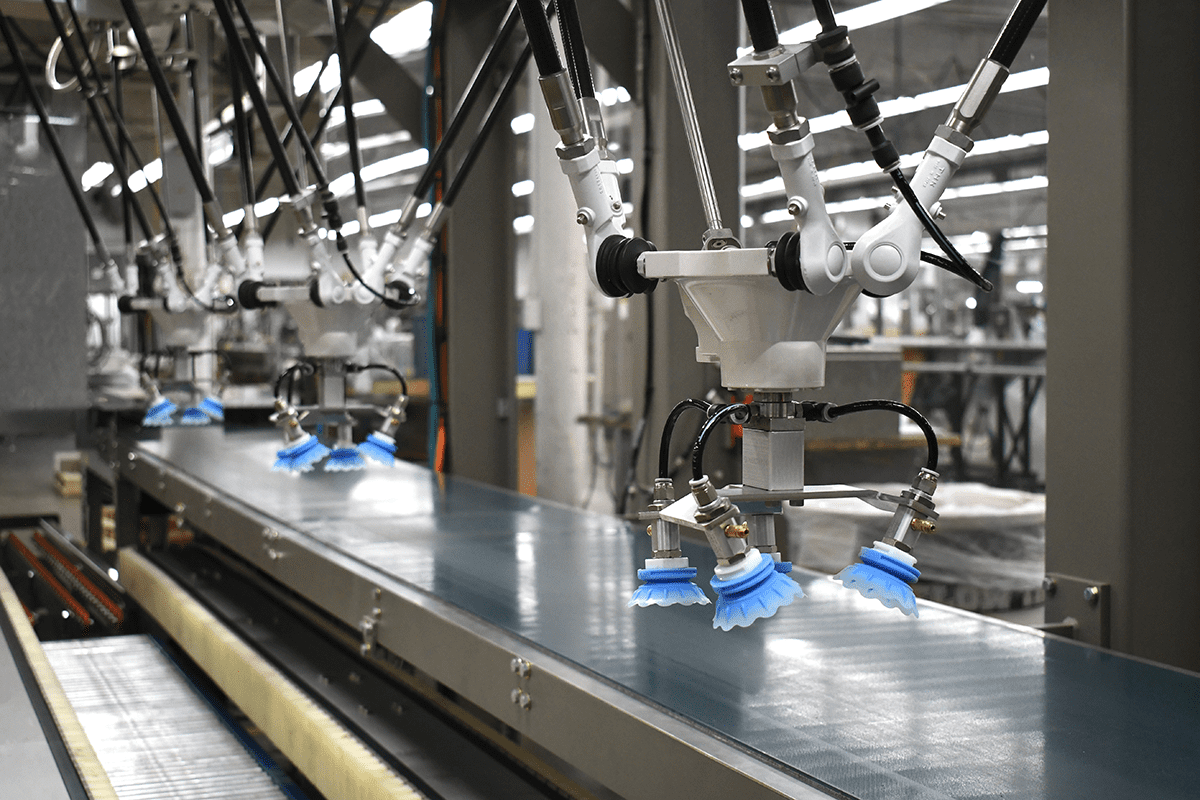
Use robot type as a fit decision, not a shopping preference:
The right question isn’t “which robot is best?” It’s “what motion, payload, speed, and changeover reality does this station actually require?”
A Practical “Go / No-Go” Checklist You Can Use Tomorrow
If you can answer “yes” to most of these, robotics is usually worth deeper evaluation:
If you’re mostly “no,” you may be better served by improved manual, semi-automation, or a purpose-built mechanical solution.
Conclusion: Make The Decision With Numbers, Not Momentum
If you’ve been living with end-of-line constraints, you already know the “present:” The pain shows up in overtime, missed targets, staffing chaos, changeover loss, and avoidable disruptions.
Now you know the “resolution:” Robotics is worth it when flexibility and stability solve a real, measurable constraint—and it’s not worth it when speed, simplicity, or upstream instability dominate your reality.
Your relevant next step is straightforward: Baseline two to six weeks of real data, price three solution tiers, model total cost of ownership, and stress-test the assumptions. That’s how you prove ROI and avoid buying an expensive answer to the wrong problem.
If you do that work, you’ll end up in one of two good outcomes:
Either way, you’ll be making the right call for your line.