Introduction
Hiring is hard. Packaging automation is getting more complex — not less. And when experience mechanics, electricians, and automation technicians retire, the pressure hits immediately: longer response times, more downtime, more firefighting.
Outsourcing to original equipment manufacturers (OEMs) and contractors is rational. In many cases, it’s necessary. But the real question isn’t:
“Can they fix it?”
It’s:
“Are we preserving control while they fix it?”
If you’re losing hands-on-know-how built up over years and increasing external support at the same time, you’re facing a strategic fork in the road: You can build resilience through structured governance — or drift quietly into vendor dependency.
This article focuses on the strategic tradeoffs that determine which path you’re on. If you’d like to go deeper on the specific operational failure modes that emerge when experienced techs retire — declining equipment efficiency, longer repair times, settings drift, and documentation decay — see our companion article The Packaging Risk Nobody Budgets For: Retiring Expertise.
When seasoned packaging technicians leave, the visible pain is obvious: more downtime and slower repairs. The more dangerous impacts are the silent ones.
On secondary packaging lines — cartoners, case packers, erectors, sealers, palletizers, robotics, conveying, coding, vision — stability depends on “work-as-done” knowledge:
Much of this lives in people’s heads. Industry workforce research from PMMI shows onboarding to independence often takes 4–6 months for operators and 4–12 months for technicians. When retirements outpace development, you don’t just run short on headcount — you lose your room for error. And that’s when the silent risks begin to compound.
The Critical Tradeoffs That Determine Your Future
Coverage vs. Competence vs. Control
Under pressure, most plants optimize for coverage: warm bodies, more contractor hours, OEM service agreements. Coverage solves today’s gap. But resilience requires three things:
Here’s the silent failure mode:
Lose control → lose competence → increase dependency → require more coverage.
If you do not own your PLC (programmable logic controller — the computer that runs the machine) settings and software history, your ideal machine settings for each product type, your change management process, and your documentation updates, then every retirement accelerates long-term decline.
TAKEAWAY
Outsource execution if needed — but never outsource ownership.
Outsourcing Shifts Risk — It Does Not Remove It
Leaning on OEMs and contractors can absolutely improve performance when structured well. It can provide specialized robotics and automation expertise, planned shutdown coverage, and modernization execution speed. Research from Packaging World has shown many consumer packaged goods (CPG) companies rely on OEM techs because hiring maintenance talent is difficult. That’s rational.
Many consumer packaged goods (CPG) companies rely on OEM techs because hiring maintenance talent is difficult.
But outsourcing changes your risk profile. It introduces new exposure:
A) Fragmented responsibility: Who owns lockout/tagout boundaries (the safety steps for powering down equipment before working on it)? Drawing updates? PLC software history? Return-to-service checks? Without single-point plant ownership, disorganization risk grows.
B) Safety & Liability Do Not Transfer Cleanly: Under OSHA multi-employer policies, more than one employer can be cited on the same job. Translation: You still own the risk.
C) Dependency Cost Creep: When contractors expand from projects into daily troubleshooting, emergency callouts increase, travel delays extend downtime, and negotiation leverage weakens.
Documentation and Baseline Ownership Decide Everything
Documentation decay is one of the most dangerous silent risks in packaging plants. It shows up as PLC tweaks without version control, wiring changes not reflected in drawings, outdated OEM manuals, no documented condition of the equipment after work is completed, and no ideal settings defined per product type.
Over time, troubleshooting becomes an archaeology project. Modernizations become reverse-engineering projects. Downtime events expand because no one knows the true baseline.
According to workforce trends highlighted by PMMI, undocumented knowledge loss is one of the largest contributors to rising maintenance strain. If you don’t control software backups, change management, updated technical records, and product-level settings governance, outsourcing accelerates decay instead of stabilizing the system.
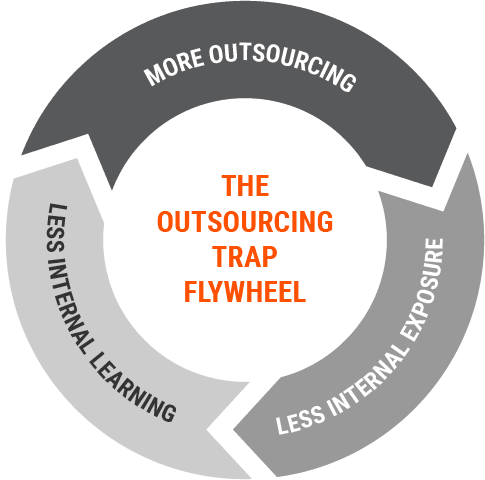
Warning: The Outsourcing Trap Flywheel
Here’s the pattern that emerges repeatedly in complex packaging environments:
More outsourcing → Less internal exposure → Less internal learning → Even more outsourcing.
Eventually, you cannot evaluate vendor recommendations. Vendor lock-in increases. Repeat failures persist. Internal confidence erodes. At that point, contractors aren’t supplementing your team — they are your team. And your cost structure reflects it.
TAKEAWAY
Dependency rarely happens through one big decision. It forms through incremental convenience.
The Minimal Internal “Spine” Every Plant Should Protect
Even if you outsource execution, you must retain a technical spine. At minimum:
PRO TIP
Outsource rebuilds, robotics programming, or planned shutdown work. But never outsource governance.
A Decision-Maker’s Litmus Test
Ask yourself:
If you cannot answer these confidently, dependency is already forming.
The Strategic Choice You’re Making Right Now
Retirements are accelerating. Automation complexity is rising. Outsourcing is increasing. Those realities aren’t changing.
The only strategic question is this: Are you outsourcing execution — or outsourcing ownership?
If you protect governance, baselines, and learning systems, outsourcing can increase resilience. If you let documentation decay and internal capability erode, outsourcing becomes dependency. Your plant’s future stability will not be decided by how many contractors you hire. It will be decided by whether you preserve control while they work.
Audit your packaging lines against the litmus test above — before the next retirement forces your hand.
Resilience is not built in crisis. It’s built in structure. And structure starts with ownership.