At a Glance
Robotic vs traditional packaging automation – which is better? Robots handle variability really well – that’s their key strength. This is done through recipes to help automate changeovers, cameras, sensors, and pick-and-place functionality. Despite their strengths, the choice to pursue a robotic system is dependent on your operation.
Robots are worth it if…
- You have a highly variable line
- Your products challenge fixed equipment
- Labor gaps and ergonomics strain your staff
Robots might not be worth it if…
- You run a single SKU for a long time
- Your upstream is unstable / unreliable
- Your tooling is ultra-custom
If a robotic system seems beneficial for your operation, the way to convince decision-makers is through the return on your investment and hard facts.
Introduction
Secondary packaging is continually evolving. What began as manual packing is now done in semi or fully automated systems. And a newer addition to the choice line-up is the robotic system.
But with many lines having never used a robot, there are still a lot of question marks when it comes to robotics:
- What are the benefits and pitfalls?
- In what lines are they best?
- And maybe most of all, why should a line purchase a robotic system rather than a traditional one?
These are all good questions. To answer in part right now, we’ll say that robotic systems fill different gaps than traditional systems. They’re not necessarily here to replace all mechanical systems, but to offer an option that particularly excels in variability, SKU expansion, and changeover.
In this article, we’ll cover:
- The place for robotic systems in a packaging line
- The strengths and weaknesses of robotic systems
- The robot that best suits different types of lines
- A framework for proving ROI to decision-makers
- A “go/no-go” checklist for robotic systems
Where Do Robots Fit Within the Packaging Industry?
Robots are not the replacement for mechanical equipment, just as mechanical equipment is not the replacement for manual labor. They simply fill different gaps, with the aim of making the most effective and efficient packaging lines possible.
Robots shine where complexity bogs down traditional automation. With recipes, cameras, sensors, and pick-and-place functionality, robots really excel in high variability.
How Do I Know if Robotics Are Worth it for My Line?
For operations who have never used a robot in their packaging line, there may be some hesitancy to jump on board.
Below, we’ll go through the strengths – the signs that robotics are worth it for your packaging line.
You Have a Highly Variable Line with Frequent Changeovers
Robotic systems can often switch formats through recipes – programmed adjustments that are automatically completed when the robot is cued.
These can make robotics investments worth it if changeovers are a regular thorn in your side. Some manual adjustments may still be needed with each changeover, but the bulk of the manual time is reduced.
Also, robots excel at adapting to new SKUs – certainly more than traditional automation. Robots need fewer change parts, with much of the adjustment happening through programming. If your line is expected to expand over the next few years, a robot could be the ideal.
Not Sure if Your Changeovers Are Hurting You?
Do a simple check through two weeks of changeovers. Track two weeks, including:
- Number of changeovers performed per shift
- Average minutes spent in changeover (including start-up)
- Scrap/rework process until first good run
If your line spends hours down every week because of changeovers, the flexibility of a robot can make a big difference. Robotics are likely your investment for stability, rather than a gamble on new technology.
Your Products Are Hard to Run on Fixed Automation
Certain products are harder to run on fixed automation. Think of products in:
- Flexible packaging (e.g. bags, pouches, pillow packs)
- Inconsistent orientations
- Irregular presentations
Uneven weight distribution, fragility, and give to pressure are common difficulties that come with these sorts of products. Running these formats on fixed automation often requires derating speed, regularly intervening manually, and clearing jams frequently.
Through recipe-guided changeovers and vision-aligned pick-and-place functions, robots are much better equipped to handle these challenges. Robotic systems are often more adaptable and more accurate in their sensing and adjusting.
Labor Gaps Are Making Your Throughput Unreliable
Let’s face it: your output cannot rely on who shows up for work. But this is the reality for many operations – and these labor gaps are also driving costs through:
- Overtime premiums
- Temp labor markups
- Missed shipments
- Line stops from understaffing
Robots are not replacements for human workers. But robots can fill roles that are chronically understaffed. Think of the manual, physically-demanding positions – a robot can do the heavy-lifting, and the human operator’s task switches to monitoring and managing.
Ergonomic Strains Are Causing Legal and Labor Challenges
Manual case handling and palletizing positions are often the culprits of ergonomic strains. These result in injuries, restricted duties, absent workers, and high turnover.
If injuries are already proving risky and costly for your operation, you can shift those costs into robotics investment. The capital investment in a robot will prove more cost-saving than injuries and disruptions for years to come.
Mixed Packs and Retail Formats Are Complicating Your Line
The more complex your needs are for product collating, printing, and orientating, the more challenging your expectations become for fixed automation. And if you find a vendor who can handle your needs, chances are each piece of equipment will run a high price.
Robots tend to handle complex tasks more effectively because they are programmed with sensors and cameras. You shouldn’t have to sacrifice operational growth because you can’t find the right equipment. Instead, explore how a robotic system might be more aligned with your expectations.
How Do I Know if Robotics Are Not Worth it for My Line?
As we said before, robotic systems were designed to fill a specific gap. This means there are cases where robots are not necessarily the right fit. Sometimes it’s the money-saving choice to go with the traditional, fixed system, or invest in labor or process improvements.
Here are the scenarios where a robotic system may not be the right choice for your line.
You Run Very Few SKUs and Are Targeting High Speed
If your operation runs only one format – or very few – for long runtimes, and are targeting high speed, you’re probably looking for a traditional case packer. They run fast, are suited to standard SKUs, and are cost effective overall.
If flexibility isn’t valuable to you, then a robot is probably not the right solution.
You Have an Unreliable Upstream Infeed
Robots won’t fix chaos upstream. If spacing, orientation, timing, or accumulation are inconsistent, line performance will suffer – robot or no robot.
Packaging lines thrive with predictable infeed. For many operations, the real project is to fix infeed and flow. Purchasing a robot may be the step to follow, but it’s certainly not the first step in the plan.
Your Product and Tooling Requirements Are Ultra-Specific
Products that require a certain level of complex end-of-arm tooling (EOAT), will likely not see the same robotic benefit of flexibility. That sort of EOAT is expensive, and it’s going to be tailored to your specific product – it probably won’t allow the full range of robotic benefits that other operations are seeing.
If your product is:
- Heavy
- Fragile
- Sticky
- Deformable
- Unusual
You may want to explore other options before seeking out a robotic solution.
You’re Not Prepared for a Support Plan
Most robotic systems require regular and detailed maintenance. You’ll want to do as much of this in-house as possible, because the more you do externally, the higher the price will become.
If you’re not prepared to follow up your robot with the proper support, you likely aren’t prepared for the in-depth level of ownership a robot needs. Expect to:
- Train technicians
- Stock spares
- Define ownership
- Respond immediately
If you can’t accommodate these needs, your overall equipment effectiveness (OEE) will probably benefit from a simpler form of automation.
Your Goal Is Low Capital, Not Total Cost Over Time
Robotics pricing is more comparable to fixed automation than you probably assume. However, depending on the level of complexity and depth of your needs, your system will probably come out more expensive than its automated equivalent.
Robots might not win on the capital front; it wins on flexibility, resilience, and long-term adaptability. If you’re only looking at the capital, robotics may not come out on top.
What Robot Should I Use in My Secondary Packaging Line?
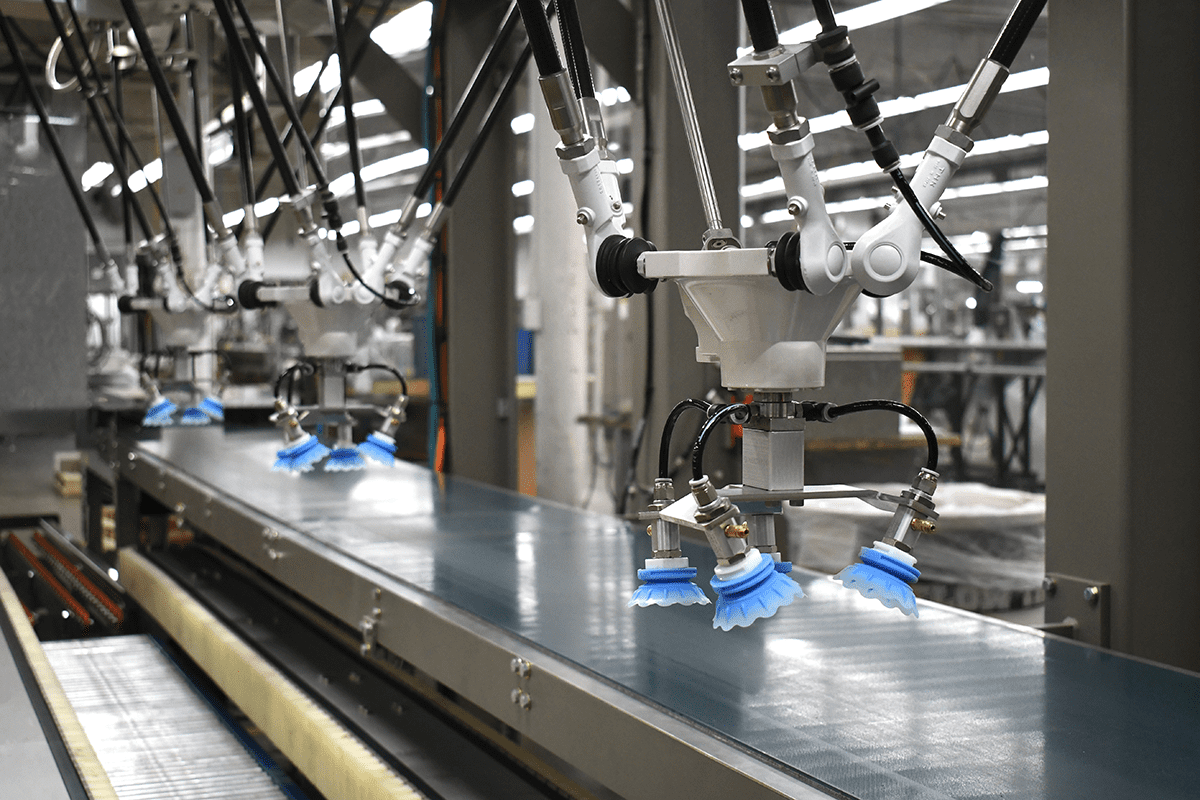
Your robot decision should be made by best fit, rather than preference. Before you can identify the robot that will work best for you, you have to know your operation inside and out. With robots specializing in pick-and-place, knowing how your case style will interact with a robot is especially beneficial.
Here are the most common robots used in secondary packaging, and the lines they’re suited for:
Robot Type
Best-Fit Operations and Functionality
Delta
Pick-and-place of lightweight items into trays and cases (usually through vision capabilities)
Articulated Arms (4/6-axis)
All-around for case packing and palletizing heavier and mixed products
SCARA (Selective Compliance Assembly Robot Arm)
Small, fast, and precise horizontal movements (often involving feeding and sorting mechanisms)
Gantry/Cartesian
Spanning large work areas or handling heavy loads (often with layer handling)
Cobots (Collaborative Robots)
Speed is lower, space is tight, and you’re aiming for quality but simplistic use (often used for lower throughput lines)
Proving Robotics ROI to Decision-Makers Before Purchase
So, you’ve decided a robot might be the solution for your line? Oftentimes the next step is to convince the company decision makers that a robot is a wise investment.
Don’t start with the capabilities – it won’t get far with Finance – instead, explain the return on investment (ROI) and monetary growth expected over the next few years. Our recommendation is to start with the proof:
1. Quantify Today’s Pain
Pull a short baseline of your current operation – something like 2 – 4 weeks. Then quantify it into three numbers:
- Labor cost at secondary packaging stations (including overtime and temps)
- Cost of lost throughput from downtime and changeovers
- Number of quality losses tied to end-of-line issues (e.g. reworks, scraps, etc.)
Lost throughput = Lost cases x Margin per case
2. Compare Robotics to Other Options
Build a comparison between robotics and at least two alternatives:
Robotics
VS.
Traditional Automation
VS.
Improved Manual Systems
Answer questions like, “What area of improvement does X focus on?” or “What does maintenance for X system look like?”
3. Use Installed Cost and Real Savings
Create a model of ROI using:
- Total installed cost
- Savings you can actually compare – based on real savings (not just wishful ones)
E.g. Reduced overtime, fewer temp hours, more line uptime, etc.
Total Installed Cost = Robot + Tooling + Guarding + Integration + Training
A key piece will be what happens to labor. Will your team be reassigned, reduced, or absorbed by growth?
4. Stress Test ROI-Breaking Assumptions
Before you pitch to your decision-making team, stress test the two assumptions that often break ROI:
- What happens when you have lower than expected performance (e.g. slower speed or more downtime than you had planned)?
- What if you can’t eliminate as many labor hours as you had hoped?
If the project still proves valuable after these questions, it’s solid. If it is only worth it in perfect conditions, maybe it’s not as credible as you had first thought.
5. Define a “Proof Plan”
Good goals are measurable – they can be tracked and followed through to completion. If you want your company to sign off on your robotics project, they need to see that there’s a plan. They need to see that you intend to follow through to completion.
Spell out for them what you will measure post-install:
- Throughput and OEE impact
- Changeover time
- Labor hours (including overtime and temps)
- Quality events
Then set a simple success threshold – the point when the project can be deemed “successful” (e.g. ROI within X months, or overtime reduced by Y%, etc.).
The “Go / No-Go” Checklist
If you find yourself answering “yes” to many of these questions, robotics is worth a deeper evaluation for your line.
If you’re answering “No” to many or most of these questions, consider a traditional machine or dedicate yourself to improving manual operations.
Make the Decision With the Numbers
Knowing these strengths and weaknesses, your next step is to make the decision. Weigh the robots on the market against your SKU-mix, throughput goals, and line specifics. Can you prove ROI? Will the decision makers in your organization align with your expectations?
Once you mull over these things, you’ll end up with either:
- A reasonable robotics proposal that your decision makers can align with, or
- A clear reason to go down a different route – with traditional automation or manual improvements
Either way, you will have taken your real line into account, and made the choice you believe will position you best for long-term growth.
Looking for Someone to Answer Questions About Robots?
Schedule a discovery call. Douglas specialists can answer questions and help guide you to the best course of action.