Introduction
Is e-commerce wrecking your end-of-line packaging performance?
Are returns, rework, and labor spikes eating your margins? In today’s CPG environment, what used to work for traditional retail packaging is now failing under e-commerce demands.
In this guide, you’ll learn how e-commerce is changing end-of-line packaging and the five metrics that define omnichannel packaging success—metrics that go beyond speed and volume. You’ll see why traditional KPIs fall short and how to realign your packaging strategy to meet e-commerce head-on.
Why E-Commerce Broke the Retail Packaging Model
If your end-of-line was designed for palletized retail distribution, e-commerce introduces new physics, new cost drivers, and new failure modes that traditional metrics don’t capture.
The shift from pallet units to parcel units means packaging must now survive harsher environments and more handling.
Why E-Commerce Bottlenecks Start at End-of-Line
Upstream processes often stay the same — but downstream, everything changes. End-of-line is where product diversity, order logic, and protection converge, leading to equipment strain and inefficiencies.
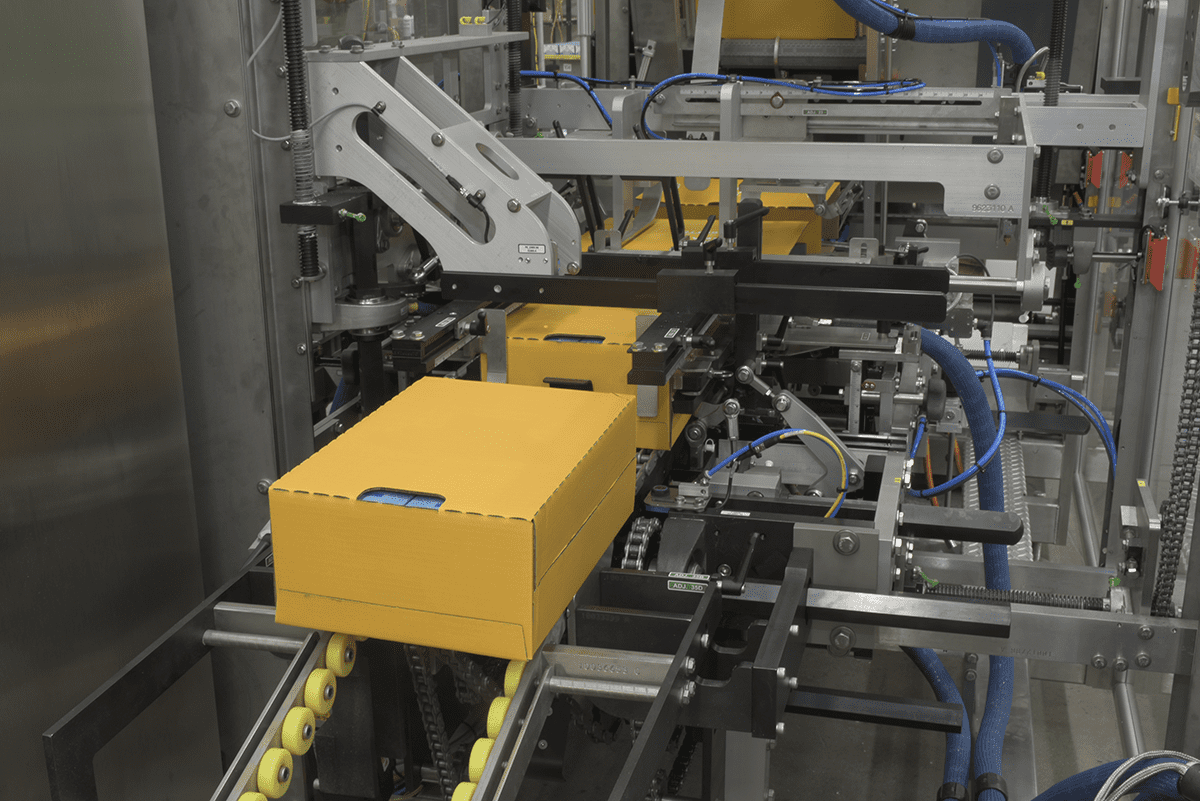
Case packers tuned for one or two SKUs are suddenly asked to run dozens, and throughput losses are caused by recovery time—not equipment speed.
The 5 Metrics That Matter in Omnichannel Packaging
Speed still matters—but it’s no longer sufficient.
High-performing omnichannel operations manage five metrics simultaneously. Each one reflects a different type of risk—cost, brand, labor, or customer experience—and improving one often pressures another. The goal isn’t to “optimize everything,” but to understand the tradeoffs by channel, SKU, and fulfillment method instead of letting them play out informally on the plant floor.
1. Damage and Leakage
Parcel networks expose weaknesses that retail distribution never did.
In traditional retail distribution, cases are unitized, palletized, and handled in relatively controlled environments. E-commerce breaks that assumption. Once a case enters a parcel network, it may be dropped, slid, tipped, compressed, or conveyed dozens of times—often at odd orientations and mixed with unrelated freight.
Damage in e-commerce is rarely random. It follows repeatable patterns tied to:
Many CPG teams rely on static lab tests—compression strength, box crush tests, or basic drop tests—to validate packaging. Those tests are useful, but they don’t fully replicate edge impacts, rotational drops, or conveyor transfers common in parcel hubs.
Why This Metric Matters
Damage drives more than write-offs. It increases rework, returns, chargebacks, customer complaints, and brand erosion. High-performing teams track damage by SKU, pack style, and channel, then use that data to refine packaging design and equipment setup—rather than reacting after failures reach customers.
2. Cube Efficiency
Oversized packaging quietly multiplies cost and complexity.
Cube efficiency refers to how closely the shipper size matches the product it protects. In retail, excess cube mainly affects pallet density and freight efficiency. In e-commerce, it triggers dimensional weight charges, where carriers bill based on volume rather than mass.
But the impact doesn’t stop at freight. Oversized or inconsistent cases:
Right-sizing sounds simple, but in practice it requires tight alignment between packaging design and automation capability. Without flexible equipment, teams often accept oversized cases because “that’s what the line can run.”
Why This Metric Matters
Improving cube efficiency reduces shipping costs and operational friction—but only when matched with equipment that can handle dimensional variability without sacrificing uptime.
3. Labor Efficiency
Variability—not speed—is the real driver of staffing costs.
When labor costs rise, many teams assume the line is “too slow.” In omnichannel environments, the real issue is usually unstable workflows caused by variation in SKUs, order composition, labeling, and exception handling.
Labor creep shows up in subtle ways:
These interventions keep lines running, but they mask systemic issues. Adding labor treats the symptoms rather than the causes
High-performing lines are designed around repeatable recovery paths, clear operator roles, and predictable handoffs between automation and people. Labor is planned as part of the system and not as a flexible buffer for variability.
Why This Metric Matters
Labor efficiency determines whether omnichannel growth scales profitably. Efficient operations minimize human intervention without removing human control—using discipline, visibility, and process design instead of headcount.
4. Compliance and Verification
In omnichannel fulfillment, errors propagate fast, and retailers and carriers now penalize mistakes automatically. A missing item, incorrect label, or weight mismatch doesn’t just cause rework—it often triggers chargebacks, rejected shipments, or customer-visible failures.
Many plants still rely on spot-checks or end-of-shift audits. That approach worked when volume was predictable and channels were limited. However, that approach fails when:
Modern compliance requires systemic verification. That means integrating scan logic, weight checks, and dimensional validation directly into the line so errors are detected and resolved before product leaves the building.
Why This Metric Matters
Compliance failures cost more than fees. They undermine retailer trust, disrupt fulfillment, and consume engineering and operations time.
5. Returns and Customer Experience
Packaging failures show up downstream, where fixes are most expensive.
Returns are often treated as a commercial or customer service issue. In omnichannel operations, they’re also a packaging systems problem.
Common root causes include:
High-performing teams don’t just measure return rates. They trace returns back to specific SKUs, pack styles, ship methods, and automation configurations, then close the loop by adjusting packaging, processes, or equipment.
This feedback cycle changes returns from a lagging indicator into a design input.
Why This Metric Matters
In e-commerce, packaging is part of the product experience. Poor performance erodes brand equity one shipment at a time—often invisibly until reviews, churn, or retailer pressure force action.
Where E-Commerce Hits the Line Hardest
Why Isolated Fixes Fail
You can’t bolt e-commerce onto a retail-optimized line. Trying to solve issues independently leads to fragmented automation and firefighting. Instead, aim to design your line around flow paths, exception logic, and decision density.
What to Do Before You Invest in Equipment
E-Commerce Isn’t About More Automation—It’s About Better Alignment
You now know the five metrics that define successful omnichannel secondary packaging. If you’re still applying retail logic to parcel shipping, you’re likely seeing rising costs, rework, and returns. If you want to realign your packaging strategy, start by mapping your true ship units and segmenting SKU damage rates.
If you would like assistance with the process, feel free to schedule a call with one of our packaging systems consultants. They can assess your current setup and help you navigate the e-commerce transition with systems thinking and real-world expertise.
Ready to realign your packaging strategy?
Let’s talk. With over 60 years of industry experience, Douglas consultants can help you navigate the e-commerce transition and master the 5 metrics to omnichannel packaging success.