At a Glance
Mean Time Between Failures (MTBF) measures average machine uptime between unplanned stops. The higher the number, the more reliable the machine is. But MTBF carries two cautions:
- MTBF is an average – it’s long-term failure frequency, not time until next fail
- Vendor-quoted MTBF is usually a design target under specific conditions
MTBF can be improved by the same methods that limit failures (e.g. maintenance, parts quality, etc.). And when you pair MTBF with Mean Time to Repair (MTTR), you can calculate Availability, which is one of the three components of Overall Equipment Effectiveness (OEE).
For more on OEE, see our article, “The Three Components of OEE: Availability, Performance, Quality (and the Six Big Losses).”
Introduction
What is MTBF? It is frequently quoted as a reliability number in a packaging equipment proposal, but it’s often misunderstood on the buyer side. Perhaps that’s because it’s usually stated as a single figure, no explanation: “24 hours MTBF.” And it’s usually read like a guarantee: “This is how long the machine will run before it breaks.”
But MTBF is more complicated than that. It’s a long-run reliability indicator, positioned as an average between failures. If you read MTBF as a spec sheet promise, you’ll set yourself up for disappointment.
In this article, we’ll cover:
- What MTBF measures, and how it’s calculated
- Why the quoted number is usually not seen in the field
- What drives MTBF on a real line
- How to calculate Availability from MTBF and MTTR
- When MTBF is the valuable choice for improvement
What Does MTBF Measure?
MTBF measures the average machine uptime between unplanned stops – in other words, it measures reliability. As it is simple in definition, it’s also simple in calculation: total operating hours divided by the number of unplanned failures.
MTBF = operating hours / number of failures
For example, if a packaging line runs for 1,000 hours over a quarter, and has 10 unplanned failures, its MTBF is 100 hours. The equation would look like this:
100 hr = 1,000 hr / 10
This “100 hours” reflects how often the equipment interrupts production and therefore measures the machine’s reliability as part of your packaging line.
Some Important Notes
- MTBF counts unplanned instances only – scheduled changeovers, planned maintenance, operator breaks, etc. aren’t unplanned failures, so they should not be factored into the equation.
-
MTBF is an average – it hides the whole distribution, and there will be extremes on either side of the number.
- A line with an MTBF of 100 hours can run for 5 hours and fail or it can run for 200 hours without a single failure.
- MTBF is meant to describe the long-term rate, not a single interval.
Design-Target vs. Field MTBF
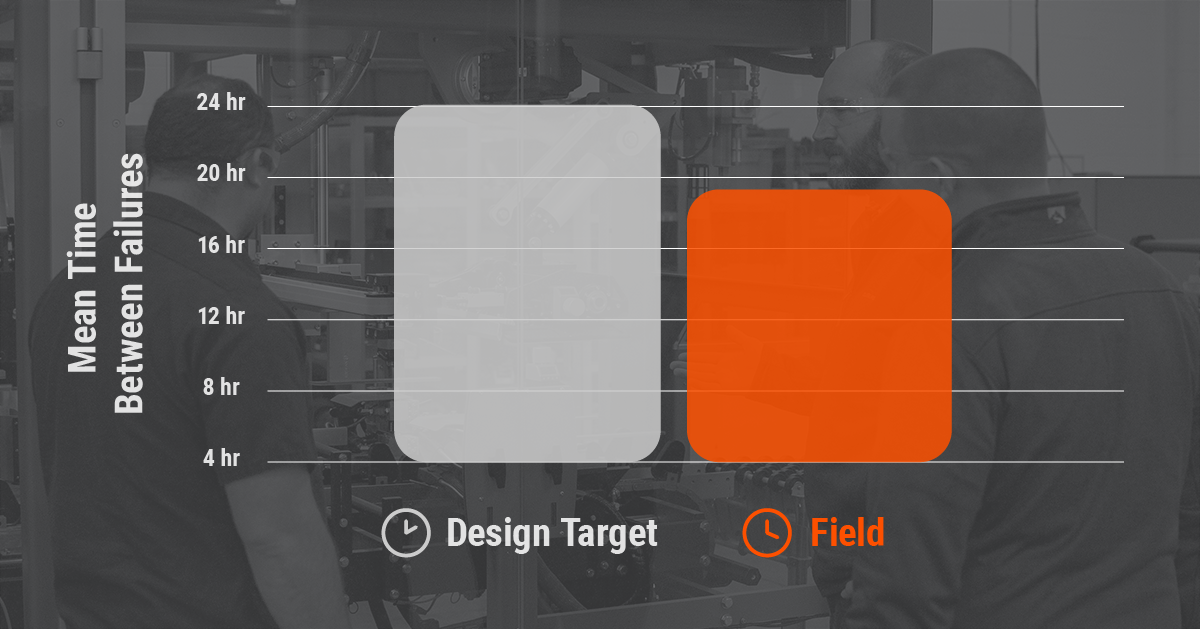
Understanding your OEM’s MTBF is an important distinction to make. Proposal MTBF’s are usually design-target figures. This means that they reflect the reliability the machine was engineered to hit under stated conditions. Your actual MTBF is referred to as field MTBF, and it really depends on how your plant runs the machine.
In the same way FAT testing is done at the OEM facility and SAT is done at yours, a vendor’s MTBF is the machine under ideal vendor conditions, while the field MTBF is the machine under your facility’s conditions. It’s possible vs. reality.
Proposal MTBF
- Design-targeted
- Tested at vendor’s facility
- Tested under ideal conditions
- Reflects possible performance
Field MTBF
- Field-validated
- Tested at your facility
- Tested under working conditions
- Reflects realistic performance
Field MTBF usually falls lower because of context, rather than defects. In your facility, the machine is running with rigorous consumables constantly, and in a demanding environment that can be hot, frequently washed, dusty, sticky, etc. And it may not get the preventive maintenance it needs, right when it needs it, due to the realistic demands of operation.
And that’s okay. It’s reality. But the lesson is that you shouldn’t take a quoted MTBF at face value without asking if it’s design-targeted or field-validated. Ask what operating conditions it assumes. And know how a controlled vendor facility may differ from your packaging floor.
What Drives MTBF?
Since MTBF measures how often the equipment stops on its own, the things that improve MTBF also limit failures:
- Design and Component Quality
Rugged mechanics, derated components (parts which intentionally run below their rated limits), and redundancy in failure-prone areas – these all raise the ceiling on achievable reliability. - Preventive Maintenance
Catch degradation while it’s still cheap, and before it does damage. Replace wear parts before they fail, and watch vibration, temperature, and current draw. This area is the most under your control. - Operating Environment
Things like heat, moisture, dust, and 24/7 operation, all wear heavily on the machine, and increase its likelihood of failing. A machine in a gentler environment will claim a higher MTBF. - Consumables and Wear Management
Consumables (e.g. films, adhesives, belts, bearings, etc.) that are out of spec or past their life will create minor failures, which will slowly but surely pull the MTBF down.
Reliability naturally changes over a machine’s life. This is referred to as the “bathtub curve.” It follows like this: a burst of early-life failures, which move into a long stable middle, and then rise into a tail of failures as components wear out.

To gain a better understanding of the bathtub curve, take a look at our article, “Equipment Failure and the Bathtub Curve: How to Extend the Life of Your Machines.”
How Does MTBF Fit into Availability?
It’s easy to get MTBF confused with another four-letter acronym, MTTR. Mean Time to Repair (MTTR) measures how long a machine stays down on average. So, MTBF is how often, while MTTR is how long.
MTBF and MTTR work together. They combine to measure Availability, which is the percentage of planned time the equipment actually runs for:
Availability = (MTBF / (MTBF+MTTR)) x 100
A line with an MTBF of 100 hours and an MTTR of 1 hour, will be Available roughly 99% of the time. But if your MTTR is pushed to 10 hours, your Availability quickly drops to 91%.
It’s important to pay attention to your Availability percentage because it’s one of the three components that go into Overall Equipment Effectiveness (OEE). Which, as the name suggests, is one of the major factors in evaluating your machine and your overall production efficiency.
Dig further into MTTR, Availability, and OEE with one of our other articles:
Know What to Shoot For
It may seem like reliability is always the right factor to purchase for, but there are times when it’s not. It really depends on your line’s constraint.
If your line fails infrequently, but has a long recovery window, then your constraint is actually recovery. If you push for great reliability in this scenario, you won’t see as much growth as you had hoped for. Pushing MTBF from high to higher brings little profit, but cutting MTTR will buy you more uptime per dollar.
This same principle can be applied to the design-target MTBF we referenced earlier. If you have a heavy-duty line, but buy for a design-target MTBF, your floor will never reach expected reliability. The reliability worth buying is the reliability your operating conditions will let you keep.
TECHNICAL NOTE
MTBF is not a countdown timer. A 100-hour MTBF does not mean the machine “has 100 hours left until it fails.” It’s a long-run average across many failures, not a fuse. Treating it as a countdown leads teams to either over-maintain on a false schedule or get blindsided by an early failure that was already allowed for.
Put the MTBF Number to Use
MTBF can be an incredibly valuable signal, as long as you read it for what it is. MTBF is a long-run average, and often a design-target measured under the vendor’s conditions. Don’t just chase a bigger number; treat the quoted MTBF as a reliability claim to test against your own line. See how it performs under a harder cycle, harsher environment, and with disciplined maintenance.
Then try pairing it with the MTTR you expect during stops, and you’ll have a decent estimate of the Availability your line will actually deliver. And you’re one step closer to better understanding your overall OEE.
Understand Your New Machine’s MTBF
Schedule a discovery call. Douglas specialists can answer questions, clarify the numbers, and help you understand your machine’s potential.