Introduction
What is DOT and AM? The terms ‘Direction of Travel’ (DOT) and ‘Across Machine’ (AM) show up constantly in secondary packaging specs, sales conversations, and engineering drawings. They’re simple concepts once you understand them, but getting them wrong can cause real problems during design, tooling, and commissioning.
The Definitions
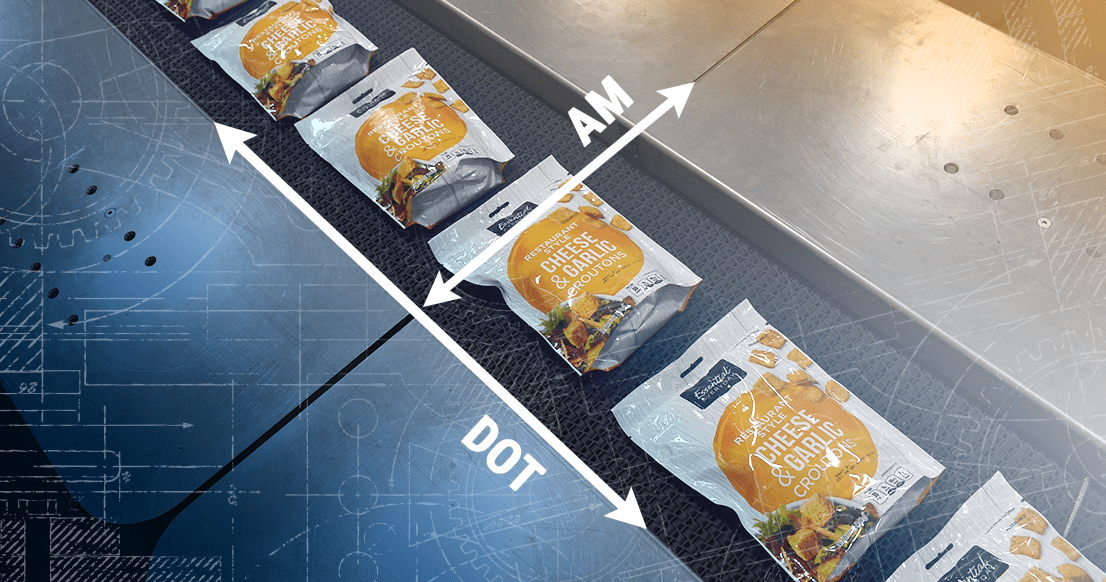
Direction of Travel (DOT) refers to the axis along which your product moves through the packaging machine. Essentially, this is the length of the machine’s flow path. If you’re standing beside a case packer watching product feed in from one end and cases exit the other, you’re watching product travel in the DOT direction.
Across Machine (AM) refers to the axis perpendicular to product flow. This is usually the width of the machine.
Pro Tip
Think of it this way: DOT is upstream and downstream. AM is side-to-side.
Why Do These Terms Matter
These two dimensions define how your product is oriented within the package, and that affects everything from label visibility to structural integrity to retail shelf appearance. In other words, if the DOT and AM dimensions are not understood correctly, the fit and display orientation of the primary pack pattern may be off.
For example, consider the most extreme (and highly unlikely) example of a 12-pack of canned beverages: Which way do the cans face in the tray? Are the tops visible from above (AM orientation) or from the end of the case (DOT orientation)? If you confuse DOT and AM, you may end up with cans laying on their sides rather than right-side up.
DOT and AM designations affect:
- How graphics and labels read when the package is shelf-stocked
- How the corrugated tray or case is engineered and erected
- How infeeds, lanes, and metering systems are configured
- Where handles, perforations, or tear strips are positioned on the packaging material
DOT and AM in Machine Spec
When an OEM gives you a product envelope (the range of product dimensions the machine can accommodate), they’ll often express it in DOT and AM terms. For example:
- Product length DOT: 3.5″ – 5.0″
- Product width AM: 2.0″ – 3.5″
- Product height/vertical: 4.0″ – 8.0″
These dimensions drive tooling design. If you change the orientation of your product relative to machine flow, you may be swapping DOT and AM dimensions. This can push you outside the machine’s operating range or require a complete tooling change or overall machine footprint change due to machine flow.
Getting This Right Before You Spec
Product orientation is one of the first things to lock down when working with an OEM on a new system. Before your first technical conversation, you should know the answers to these questions:
Defining these early avoids costly changes downstream and keeps your machine specs grounded in how the line needs to run.
Need to Discuss DOT and AM?
Give us a call. Douglas specialists are ready to help answer questions and guide you to simpler and more productive secondary packaging.