Introduction
Top load vs horizontal load case packing – how do I know what’s right? When you’re evaluating case packers, one of the first questions you’ll run into is load orientation: Should products enter the case from the top or from the side? The answer isn’t arbitrary—it’s driven by your product, your pack pattern, your line layout, and your throughput requirements.
Here’s a clear breakdown of both.
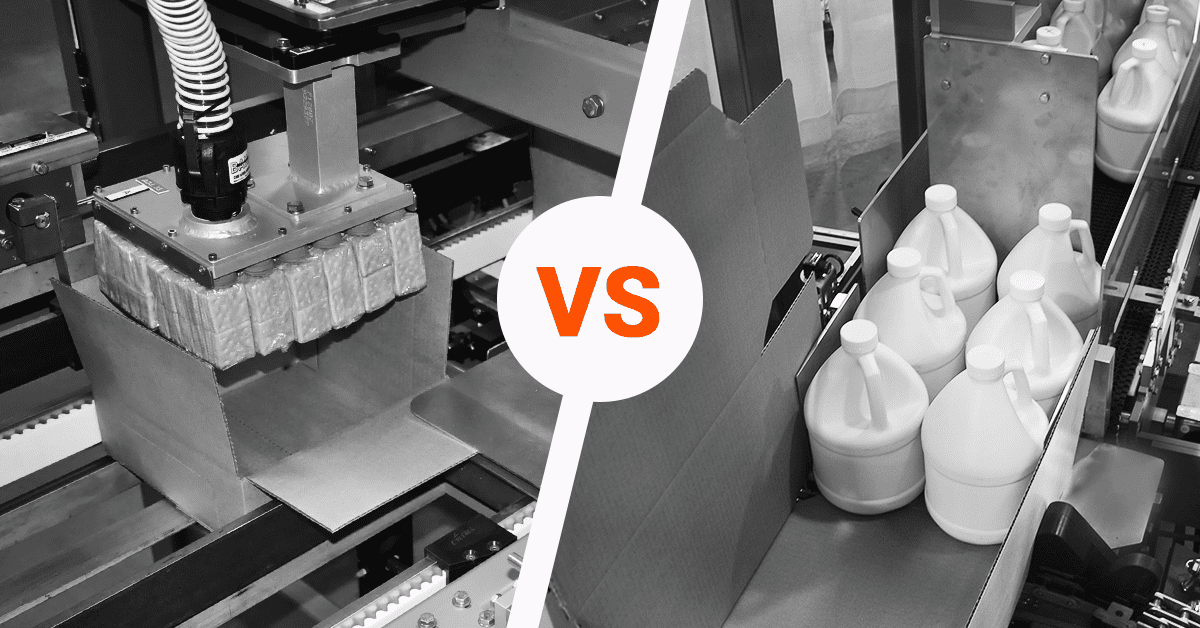
Horizontal Load (Side or End Load)
In a horizontal-load configuration, products are pushed or slid into the open end of a knocked-down or wraparound case or tray. The case blank is erected, and the product group (typically metered and collated upstream) is loaded from the side.
Horizontal-load machines are generally well-suited for:
In most cases, machine efficiency is negatively impacted by picking the product up to put it into the top of a case. In this respect, side loading is advantageous for many applications. However, if the orientation of the product relative to the primary package type makes it difficult to collate within a side-load theory of operation, top loading can be a great alternative.
Top Load
In a top-load configuration, products are placed, or dropped, vertically into an open-top case or tray from above. The case or tray is erected and conveyed beneath the loading zone, and product is placed from overhead.
Top-load machines are generally well-suited for:
Top-load machines often run at lower speeds than horizontal load, and the overhead loading mechanism sometimes adds mechanical complexity and an overall decrease in machine efficiency.
Does It Have to Be Either/Or?
Not always. Some applications use a top-load machine with additional mechanical support, and some machines are designed to handle both formats depending on the product range. The key is knowing your full product portfolio before you select a configuration. A machine that’s ideal for your current lineup may not handle the SKU you’re adding in two years.
Pro Tip
If you’re unsure which orientation fits your application, bring both product samples and packaging specs to your first technical discussion. That conversation goes much better with actual product in hand.
Need Help Evaluating Case Packers?
Knowing which packaging equipment is the best fit for your product can be difficult. Our goal is to make it simple. Schedule a discovery call with a Douglas specialist to discuss your production goals, needs, and options.