Introduction
At a Glance
Packaging equipment service agreements outline both contractual expectations, and the sort of partnership you’re entering into. Who you sign with will be your provider when you, your operation, or your machine needs support. These agreements typically cover the following topics:
- Response times
- Preventive maintenance (PM) plans
- Parts availability and billing
- Remote support opportunities
- Training coverage
- Support hours and routes to escalation
- Controls, software, and obsolescence support
The way your provider manages these topics, with what detail, and how genuinely, matters immensely. The service agreement is your opportunity to scope out whether your provider is truly trustworthy, or if they are merely going for the highest sale.
There’s no feeling worse than staring at a contract that’s an enormous investment and realizing you don’t understand what it’s saying. You know enough to value its importance, but not enough to truly understand.
The next time you look at a packaging equipment service agreement, you can avoid that feeling altogether. This article offers a comprehensive guide for packaging equipment buyers to understand everything from the headers and body text to the charts, to the fine print.
In this article, we’ll cover:
- What a packaging equipment service agreement is
- What you can expect to see in a contract
- How to understand common coverage tiers
- Why you might opt out of a full coverage plan
- Some red and green flags to check for before signing
- What you can expect from a good service partner
What Is a Packaging Equipment Service Agreement?
A packaging equipment service agreement is a contractual document that officially partners you, and your operation, with a service provider. Your provider will often be an Original Equipment Manufacturer (OEM), a vendor, or third-party. It’s someone who is familiar with and qualified to provide machine support.
Regardless of who will be providing your service, all agreements are made up of a handful of components. Some may be easily understood, and others might be new. They will cover a range of topics from provider commitments to coverage and support, to hours and prioritization.
Think of the agreement less as a binding contract to strict hours and expectations, and more like a commitment to a trusting relationship with a service provider. It should be someone you can trust, and who you believe truly cares for the success of your operation.
What Does a Packaging Equipment Service Agreement Include?
As we mentioned before, a service agreement covers many topics. While most agreements will carry similar themes and components, actual commitments will vary from provider to provider. Here are some topics that will likely be covered in your document:
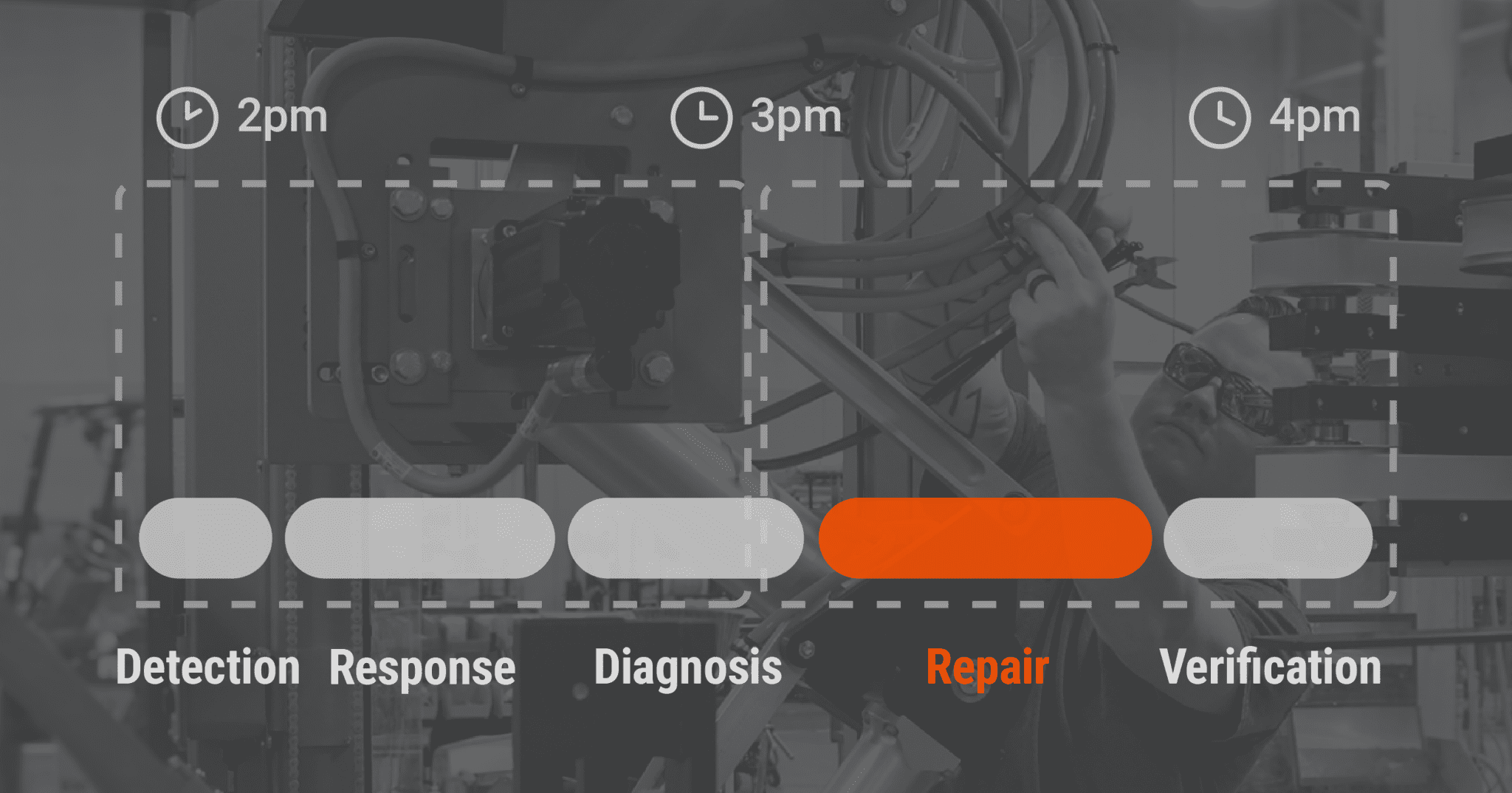
Response commitments refer to how quickly the provider will engage with your need for service, and how quickly you can expect to return to production. It covers the speed at which the provider answers the call, dispatches a service technician, and begins remote diagnosis. It essentially refers to the time between when you place a service call and when the provider takes supportive action.
In rare cases, providers may offer resolution commitments as well. These refer to how long the provider expects service to take until the equipment is up and running again. It’s typical for this guarantee not to be included in the service agreement, as it’s very difficult for providers to accurately predict downtime. In general, it’s more common for resolution estimates to be given during individual calls and service incidents.
Preventive maintenance (PM) is likely one of the more familiar sections. It refers to scheduled visits from your provider to service wear parts, and catch developing problems. It’s much like a yearly wellness checkup one might experience with a doctor’s office. The difference is that it may not be “yearly” – it could be weekly, monthly, quarterly, or any specified amount of time. It just depends on the care of your provider and the wear-down of your machinery.
This section outlines whether your agreement covers spare parts. It will list which spare parts are included, at what price, and what a typical lead-time might be. This is a key section to be aware of: parts availability is one of the largest drivers of downtime. Even if the section seems short, it will give you an idea of a provider’s preparedness to address typical parts servicing.
Remote support is a newer addition to service agreements, as it describes a provider’s ability to diagnose and resolve issues online or over the phone. The benefit is that you can avoid the wait time and expense of a technician traveling to your plant. However, remote support is not a guaranteed fix. It’s a good option to explore as it may offer the fastest and easiest solution to machine downtime, but there’s still the possibility of a tech visit, if the situation requires it.
If the training section is offered, it outlines how much your provider will cover in operator and maintenance training, versus how much will be your responsibility to manage. Scope of training varies depending on provider (for example, they may provide a bundled offer or bill separately). And sometimes, training may not be offered at all.
You should be aware of how your provider addresses training, as you want experienced and knowledgeable staff to reduce the impact of future incidents. Understand the scope of your training responsibilities before the new hire comes.
Coverage hours and escalation explain whether support is business-hours only or 24/7 service. It also explains how escalation is prioritized, defining a path when problems aren’t resolved at the first level. This can reveal your provider’s commitment to integral service.
There is also a distinction between providers in how they offer 24/7 support. At Douglas, calls during most hours of the week are answered directly by a Douglas technical advisor. For holidays and off-hours, there could be up to a 30-minute wait for our technical advisor to return your call. Whatever your provider offers, it’s important for you to understand what kind of service to expect. Is it just an answering service which is followed up by an actual human call, is it knowledgeable responders at first call, or a combination of the two?
Controls and obsolescence support highlights how your provider promises to respond to aging electronic components. It also explains coverage for software, controls, and upgrades, and may sometimes include services such as identification of obsolete parts and audits.
What are Coverage Tiers and How Do They Work?
Coverage tiers in packaging service agreements are much like health insurance plans. They explain coverage options, and prompt the question: what are you willing to pay for certainty? What are you willing to cover and address on your own?
Based on prior experience, your operation, and your machine, you should have some idea of what you are equipped to handle in-house, and what will require provider support. Here are some common coverage tiers:
Coverage in pay-per-incident and time-and-materials tiers usually means that provider services cost nothing until something breaks. If they offer any definite support, it’s limited and puts you in a queue behind contracted customers, with less availability and fewer cost options.
A standard agreement typically bundles PM, priority response (over non-contractual customers), and some varying remote support. As a solid middle-tier, it provides more than pay-per-incident typically does, but not as much as a premium agreement.
The premium agreement builds upon the standard agreement by adding firmer resolution commitments. This likely includes extended around-the-clock coverage, parts stocking or guarantees, and sometimes performance commitments tied to uptime.
An important note to make with tier labels: it matters less what they’re called and more what they offer. A “premium” plan that’s vague on resolution and parts, may be less protective than a standard plan that is well-specified. Consider the cost your budget can afford, what your experience merits, and what components you deem a need for your operation.
When to Opt-Out of (and In-to) the Full-Service Agreement
As OEMs ourselves, we honestly admit that there are scenarios when a full-service agreement isn’t automatically the right purchase. Having informed buyers with the straight answer matters more than the upsell. So, here is a case that likely merits a declined full-service agreement:
- You run a strong in-house maintenance team, who has a deep familiarity with the equipment
- You have complete and current documentation
- You have invested in training
- Your critical spares for parts and obsolescence are stocked, and on-site
If this is you, a full agreement may duplicate capabilities you already have in-house. Instead, consider pay-per-incident support for the case of rare specialist problems. It’s always nice to have someone to call, should something move beyond your capability.
On the other hand, the case for a full service agreement grows with how critical the machine is to overall operations. The cost of downtime for your specific machine, and how critical your production is to company success, should both be accounted for in your decision.
Red and Green Flags in Signing
Before signing a service agreement, there are expectations that should be met. However, there are also things that should raise “red flags” in your mind. Here is a list of some we think are worth questioning:
None of these are necessarily deal-breakers, but each can hide sub-par service under the word “covered.” In contrast, here are some “green flags” that show a provider has addressed actual concerns for downtime and support:
We called these “green flags,” but they’re really just good practices, and signs of a trusted partner.
Note: Something valuable to recognize is whether your provider understands your company’s operation, priorities, and values. It’s critical to have alignment on both sides of the relationship, so vendors know what’s truly important to the customer and what’s not.
How to Evaluate If You’ve Found a Trustworthy Partner
Good coverage is defined by outcomes, not labels. It has to do with who you agree to partner with. Are they someone who seems genuinely interested in the best care for your operation? Or are they simply just pushing the sell?
Find someone who commits to getting you running again, with the best service. Someone who specifies PM and parts, and who sizes care according to the line you have. Also, make sure your provider is someone who will keep you accountable – someone who will check in with your operation and provide feedback on how you’re doing in maintaining your equipment.
Read a service agreement as you would any other machine spec: compare its commitments with what your operation actually needs. That’s how you ensure you sign with a partner that you can truly trust and rely on.
Questions about Your Douglas Service Agreement?
Schedule a discovery call. Douglas specialists can walk through items and help clarify questions.