Introduction
At a Glance
Manual vs robotic magazine loading – which should you choose? On many points, manual magazine loading wins out, but with labor availability issues and ergonomics strains, robotic magazine loading presents a valuable alternative.
Manual Loading
- Faster
- Flexible and Adaptable
- Performs Inconsistently
Robotic Loading
- Reliable
- Physically Capable
- Faults with Variability
The answer to “Which is Better?” is often dependent on necessity and operational specifics. What does your operation look like? What constraints exist? Which method balances your needs best?
Magazine loading is the first step of the case packing process, but it doesn’t often see the spotlight. It’s often overlooked, but can quietly cause injuries and strains, stops and misfeeds. Those looking for a solution for magazine loading will likely find two options: manual or robotic.
But which option is better? That’s a good question with a complex answer – and it probably depends on your operation. Simply put, manual loading tends to be preferred, but in the reality of labor availability and cost concerns, robotic magazine loaders pose valuable alternatives.
In this article, we’ll cover:
- What magazine loading is and what methods exist
- How manual and robotic loading processes differ
- The strengths and weaknesses of either method
- Operational constraints that lead to one solution or the other
- Questions to evaluate before beginning the buying process
What Is Magazine Loading? And How Do Manual and Robotic Systems Differ?
Magazine loading refers to the process of loading blanks into a packaging machine’s magazine – the storage reservoir that the machine erects cases or trays from. It’s a simple reality for almost any operation: if you handle cases or trays, magazine loading is relevant to you.
In our current market, there are two main methods of magazine loading:
1. Manual Loading
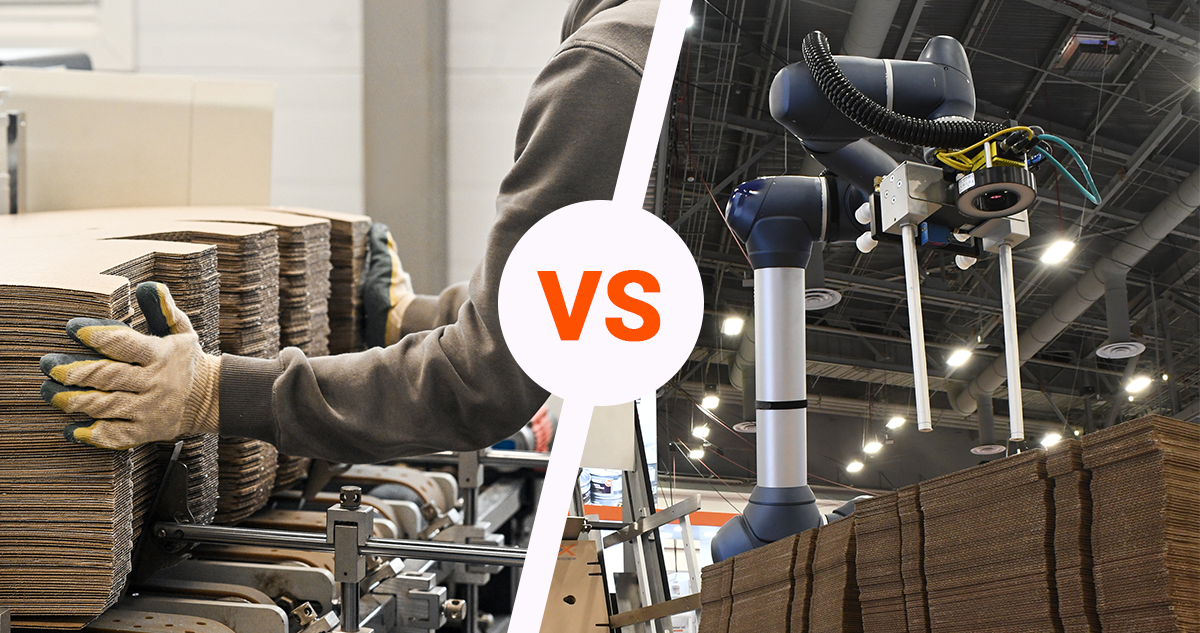
A dedicated operator lifts stacks of blanks and places them into the magazine by hand.
2. Robotic Loading
A robotic system uses a pick-and-place function to move stacks of blanks into the magazine.
In most aspects, automated wins over manual operations in speed and quality, consistently. In magazine loading, it tends to differ. Manual loading generally outperforms robotic magazine loading on many accounts. But, robotic loading still has its place, and in a world of labor shortages, it holds its own.
Manual vs. Robotic: Strengths, Weaknesses, and Operations Where They Excel
If manual loading is generally stronger, why do robotic magazine loaders exist? Because either method has its own strengths and weaknesses, and what works for one operation might not work for another. To understand what will work for yours, take a look at the places where either method excels:
Manual Magazine Loading
STRENGTHS
- Flexible to Variation
If blanks are crooked, misaligned, or damaged, the operator can quickly see and remedy the issue while loading. - Speed
While operator rates will vary, we haven’t seen a robotic magazine loader that can beat the speed of an effective human operator. They can keep up with machines that output over 100 cases per minute (CPM), when loading full-time.
WEAKNESSES
- Inconsistent Performance
Human operators naturally tire and slow, performing differently from day-to-day; different operators perform at different rates. - Ergonomically Challenging
Magazine loading is a physically taxing task, which requires sustained strength and energy. This makes it prone to injuries and strains.
Manual loading generally comes out on top because the flexibility of a human operator is hard to beat. The hinge point is with the pallets of case blanks. These stacks tend to vary in quality – often twisted, misaligned, or damaged. A human operator notices, adjusts, and continues work with little difficulty. That’s why manual loading is typically favored.
Should Manual Loading Be a Priority for My Operation?
However, if labor availability is really an issue for your operation, manual magazine loading may be easier said than done. If you’re evaluating whether sticking with this method should be a priority for you, manual loading tends to prove especially valuable for situations with:
- High SKU Variability – Cases range from very small to very big, and different sizes cycle through frequently. Human operators can adapt to different sizes quicker and without additional cost.
- Limited Capital and Floorspace – While labor costs are generally higher long term, they don’t require lots of capital upfront; without guarding or sensing needs, human operators don’t need lots of floorspace.
If either of these situations applies to your operation, manual loading may be a valuable priority for you. Consider pushing through labor availability issues or dedicating increased budget to staffing.
Robotic Magazine Loading
STRENGTHS
- Consistent Performance
The robot can ensure a certain level of accuracy and excellence in its task, which gives you a measure to rely on. - Physical Capability
Without human ergonomics concerns, robots can handle large and heavy cases without strain.
WEAKNESSES
- Conditionally Inflexible
The robotic loader is only as good as the material it’s provided; if you can’t ensure consistent pallet quality, variability can pose a challenge. - Human Dependent
Robots can’t remove additional protective measures like dunnage and straps; they still need a human operator present.
Robotic loaders can guarantee a certain level of performance, a certain throughput, and a certain payload. That reliability feels good to depend on. But they’re generally slower than manual loading, and they can struggle to deal with variation in pallets of case blanks.
Should Robotic Loading Be a Priority for My Operation?
Given the inflexibility of robotic loaders, some operations may find them challenging when compared with initial expectations. However, operations with realistic expectations and proper training will see real value from the addition of a robotic loader to their line.
Just like in manual loading, robotic loaders prove especially effective in operations that lack the robot’s strengths. We often see this sort of alignment in operations with:
- Labor Availability and Cost Issues – It can be hard to staff repetitive, physical positions. When labor availability is limited and costly, robotic solutions offer a reduced head count.
- Large and Heavy Cases – Operations who run larger and heavier case sizes find value in robotic reliability. Robots don’t pose ergonomics concerns; strains and injuries from heavier cases will likely be reduced.
If either of these situations describes your operation, you may want to consider a robotic magazine loader. Despite the fact that robotic loaders still require some operator attention, a good robotic loader will still reduce your headcount and avoid injuries and strains.
Will Robotic Loading Work for Me? Evaluating Your Operation
If you’re exploring the possibility of a robotic solution, you may be wondering what concerns you should have settled before talking to vendors. Evaluate the following points for your operation to better understand whether robotic loading will work for you (and if so, what type of robotic loader will meet your needs):
- What is the quality of my pallets and case blanks? Can my supplier meet consistency targets?
- What rate do we need to sustain to meet throughput targets? Can a robot accommodate that?
- Are we open to adjusting our cases? Can we add holes or different tooling features?
- What capital cost can we afford, and what footprint can we manage?
- Are we looking for a cobot or robot system?
Aligning Expectations with Market Realities
As original equipment manufacturers (OEMs), we’re often met with challenges in customer expectations. The market for robotic magazine loaders isn’t as advanced as other areas of automation (e.g. case packers or cartoners). The robots, as they are now, are not perfect solutions.
Customers often come to us, either expecting the robot to dramatically outshine their manual operations, or more realistically, expecting the robot to help with consistency and labor issues. It may be helpful to align your expectations with the latter group now. Understand the reality of what robotic magazine loaders can do, and you’ll likely find a smoother buying process and a better result.
Interested in Exploring Robotic Magazine Loaders?
Schedule a discovery call. Douglas presents a unique solution to the market of robotic magazine loaders. Speak to one of our specialists to evaluate whether it’s right for you.