Introduction
At a Glance
Lockout/Tagout (LOTO) is a federal safety requirement governed by OSHA 29 CFR 1910.147. It states that all hazardous energy sources on a machine – electrical, mechanical, hydraulic, pneumatic, and others – must be de-energized before any maintenance work begins. The procedure outlines eight steps: prepare, shutdown, isolate, lock/tag, release, verify, service, and restore. Read on to learn what each step entails, as well as the “Why” of LOTO, and where LOTO may be going in the future.
You hear the phrase “lockout/tagout” or the acronym “LOTO” thrown around in our industry. Do you know what it means? Could you run procedures? Do you know that it’s a federal requirement with fines reaching up to tens of thousands of dollars for violators?
However you answered these questions, the reality doesn’t change: many companies don’t properly train or implement LOTO procedures. This means that millions of near misses happen all over the country, and workers likely don’t realize they’re endangering themselves or their peers.
So, whatever our background knowledge, we could all do with a refresher on the ins and outs of LOTO procedure:
- Prepare
- Shutdown
- Isolate
- Lock/Tag
- Release
- Verify
- Service
- Restore
Keep reading to better understand these eight key steps, the “Why” behind them, the alternatives to them, and the future of them.
In this article, we’ll cover:
- What LOTO is and why it matters
- What counts as a hazardous energy source
- The three responsible roles within LOTO procedure
- A detailed explanation of the eight steps in LOTO procedure
- Alternative methods to LOTO and their impracticality
- The place of LOTO within a technology-savvy age
- The necessity of compliance with LOTO procedures
What is Lockout/Tagout (LOTO)?
Lockout/Tagout (LOTO) is a federal safety procedure for all equipment that harbors hazardous energy. The goal is to keep these “hazardous energy sources” from releasing unexpectedly, so operators and bystanders stay safe.
The main way LOTO does this is through physical locks and tags on hazardous sources during servicing. However, the actual locking/tagging is only one of six official steps (or eight steps if you’re following the Douglas model). The total procedure involves de-energizing sources and confirming safety before locking/tagging – or servicing – begins.
The “Why” Behind LOTO
At its heart, LOTO is more than a legal requirement. It’s a safety model. LOTO exists so that every worker goes home safely at the end of the workday.
LOTO is managed by the Occupational Safety and Health Administration (OSHA), within the U.S. Department of Labor. So, its purpose aligns well with that of OSHA’s. According to their website, “OSHA’s mission is to assure America’s workers have safe and healthful working conditions free from unlawful retaliation.”
Proper compliance with LOTO is meant to turn your safety goals into reality. You want to keep yourself and your coworkers safe, and LOTO gives you the framework to do that. Accident-free working conditions also have the added perk of no legal consequences, unexpected plant accidents, or insurance premium increases. It keeps your body and your balance sheet in-tact.
Take this scenario, for example:
A machine jams, and a maintenance technician reaches into the conveyor roller assembly to clear it. Thirty meters away, someone at a control panel restarts the line, without confirming that the technician had finished service.
Just like that, the machine re-engages, and the rollers catch three fingers.
Not only has someone suffered a physical injury, but it’s also likely that legal liability will ensue, and an insurance claim will be filed and added to company record. One simple ignorance degraded the reputation of your company.
Accidents like this one are the “Why” behind LOTO. When LOTO is properly done, good communication is promoted, workplace confidence is gained, and accident avoidance is secured.
What Counts as a Hazardous Energy Source?
LOTO is enforced in response to hazardous energy sources. But what really counts as a hazardous energy source? And how do we know when LOTO should be used?
The OSHA website lists that hazardous energy sources can fall into any of the following (or more) categories:
- Electrical
- Mechanical
- Hydraulic
- Pneumatic
- Chemical
- Thermal
This means that any machinery in your facility with electrical motors, hydraulic pressuring, or other “accidents waiting to happen,” gets locked and tagged for the safety of your workers and assets.
For a comprehensive list of what’s included in LOTO regulations, see OSHA’s full guide.
What Counts as a Hazardous Energy Source?
LOTO is enforced in response to hazardous energy sources. But what really counts as a hazardous energy source? And how do we know when LOTO should be used?
Cartoners
Case Packers
Stretch Wrappers
Palletizers
Electrical
Autopopulated Label (Mobile Only)
Motors
Autopopulated Label (Mobile Only)
Motors
Autopopulated Label (Mobile Only)
Turntable motors; servo drives; variable frequency drives (VFDs)
Autopopulated Label (Mobile Only)
Servo motors; VFDs; servo amplifiers
Pneumatic
Autopopulated Label (Mobile Only)
Solenoid valves for flaps/sealing
Autopopulated Label (Mobile Only)
Filter, regulator, lubricator (FRL); supply units
Autopopulated Label (Mobile Only)
N/A
Autopopulated Label (Mobile Only)
Gripper and vacuum systems
Hydraulic
Autopopulated Label (Mobile Only)
N/A
Autopopulated Label (Mobile Only)
N/A
Autopopulated Label (Mobile Only)
Pressure systems
Autopopulated Label (Mobile Only)
Arm actuation
Mechanical
Autopopulated Label (Mobile Only)
Rotating cams and linkages
Autopopulated Label (Mobile Only)
Reciprocating arms; rotating drums; raised platforms
Autopopulated Label (Mobile Only)
Rotating turntables
Autopopulated Label (Mobile Only)
Stored energy in springs and counterweights on raised stacks
To help you with any machine-specific LOTO requirements, take a look at your machine’s manual.
Another important note: your employer might have their own safety expectations. Pay attention to what’s required of you as both an employee, and an operator.
The State Caveat: OSHA State Plans Might Add Requirements
We wrote this guide according to OSHA’s federal guidelines. While twenty-two states and territories operate OSHA-approved programs, several have their own LOTO requirements.
Washington, Kentucky, and Alaska have been known to go further than federal standards. If you work in these states, you might expect more detailed training requirements, stricter documentation, or higher penalties for violators.
Confirm whether your facility operates within a state plan and make sure that you know all the requirements at-play.
Who is Responsible for LOTO?
Employees who operate, supervise, or step onto the production floor at any point, should have an idea how their role relates to LOTO. In secondary packaging or consumer packaged goods, this ends up being almost everyone.
If you’re looking for a more specific answer, OSHA does highlight three responsibility roles. Check out these categories to understand how you fit into LOTO procedure:
Authorized Employees
Designated by the employer to lockout and/or tagout machines.
Note: ONLY authorized employees are legally permitted to apply and remove locks and tags
- Must be trained in full LOTO procedures
- Must understand the hazardous energy sources of each machine
- Are accountable for lock correctness
Affected Employees
Those whose job requires them to operate or work on a machine where servicing or maintenance occurs during lockout OR those whose job requires them to work in an area where such servicing occurs
- Must be trained in the energy control program
- Must understand LOTO procedures for the machines they work on or near
- Must know not to restart equipment that is locked out
- Must communicate with authorized and other employees about lockout status
Other Employees
All other employees whose work operations may occur in an area where LOTO procedures may be used
- Must receive instruction about LOTO procedures and the danger of restarting equipment during lockout
- Must understand the basics of the energy control program/LOTO procedures
Think back to the conveyor-jam “finger incident” mentioned earlier. That accident occurred because someone in the “Other Employee” category restarted the line without confirming that the maintenance technician had finished. All three roles are responsible when something goes wrong.
Don’t Blame the Worker, Inspect Management
It’s easy to blame key operators when LOTO is violated, but the most common LOTO citations occur on the management side:
- In energy control procedures (Section 1910.147(c)(4)): there is inadequate or missing written procedure for serviced equipment.
- In training and communication (Section 1910.147(c)(7)): employees are not adequately trained on their equipment or within the energy control program.
- In periodic inspections (Section 1910.147(c)(6)): annual requirements are overlooked, or are completed, but by someone who doesn’t meet qualifications.
LOTO Procedure: the Eight Steps Explained
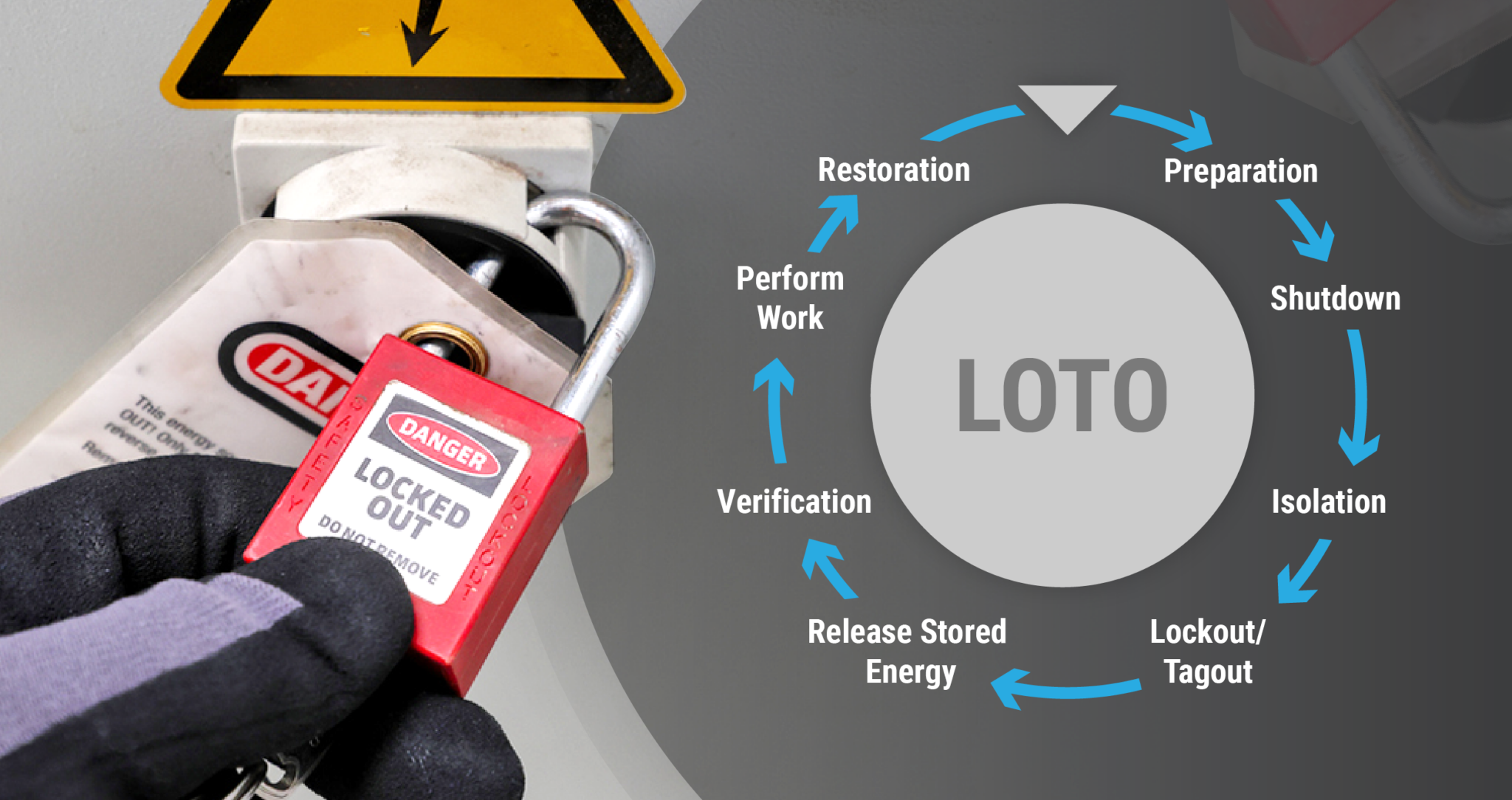
LOTO procedure is made of six official steps, but ours has eight. We’ve chosen to include two additional steps so LOTO can be visualized as a cycle – from operation to operation again:
- Prepare
- Shutdown
- Isolate
- Lockout/Tagout
- Release
-
Verify
Double-check that all energy sources are completely at rest.
There are three standard methods for doing so:
- Restart testing: attempt to start the machine using normal controls.
- Instrument testing: use a voltmeter or pressure gauge to test for energy at the isolation point.
- Direct connection testing: connect a test instrument directly to the isolation, making sure it’s not masked by check valves.
Instruments should be tested for operation both before and after use.
- Service
- Restore
Regardless of what needs servicing, locate all sources and safely disconnect parts – electrical motors, pneumatic solenoids, mechanical linkages, hydraulic pressuring, etc. Obtain necessary forms, and alert affected employees.
Shutdown the machine as normal – push the STOP button, flip the switch, close the valve, etc. Make sure all moving parts have come to a complete stop.
Physically isolate equipment from energy sources. You might need to use an energy-isolating device.
Apply physical locks and warning tags to all energy sources.
When the source can’t be locked, tagout is allowed without locks, but this should be done sparingly and always with proper documentation.
Release any lingering energy. This can sometimes occur, even though sources have already been isolated.
Safely conduct maintenance, knowing that equipment is in a zero-energy state and locked out.
Remove tools and debris, locks and tags. Notify affected employees and confirm a cleared workspace, before restoring energy in the machine.
Exceptions to LOTO: the Hassle of Alternative Methods
OSHA recognizes a few exceptions to LOTO, which they call “alternative methods.” These are for minor servicing only (e.g. jam clearing, make-ready, tool changes, etc.).
If you pursue alternative methods, you might be surprised by all documentation is required to cover:
- Risk assessment
- Method justification
- Standards, approval, and training qualifications
- Task description
- Hazardous source inclusions
As you might expect, documentation can become quite tedious and time-consuming. So understandably, alternative methods can be a hassle and aren’t pursued often.
If your employer tells you to do an alternative method, but they don’t have full documentation or approval, you are still legally obligated to conduct LOTO procedure.
Do We Still Need LOTO?
Current LOTO standards were written in 1989, and modern technology has made great control advancements since. With servo-driven safe motion, programmable logic controllers (PLCs), and computer-based isolation technology, you may be wondering, “Do we really still need LOTO?”
OSHA recognizes and agrees that there is a gap between what is required and what now exists. Released information suggests that OSHA is exploring LOTO rulemaking updates. However, these were targeted for release in late 2025, and as of this article’s publication, no proposed rules have officially been issued.
What this means is that full, physical LOTO is still the default requirement.
If or when OSHA does modernize LOTO standards, facilities that run newer systems, and original equipment manufacturers (OEMs) that build those systems, will likely find themselves positioned well to meet new compliance requirements.
Yay or Nay, LOTO’s the Requirement
No matter your opinion, LOTO is not optional. While alternatives exist, full LOTO is still the easiest, proven way to comply with federal requirements.
The attitude you display and the role you fulfill within LOTO speaks volumes to your prioritization of safety and compliance. Whether you are an authorized employee who applies locks, an affected employee working on or near the machine, or another employee who is within the affected area, your role matters. You are part of a system that prevents injury and death for yourself, your coworkers, and your friends.
Understand the eight steps, know your role, and follow through. When the maintenance technician leaves with all ten fingers, he will thank you.
Want to Improve LOTO on your Douglas Equipment?
Schedule a discovery call. Douglas specialists can answer questions to help ensure your practices are aligned with LOTO requirements.