Introduction
At a Glance
Top load case packers are for products that are suited to pick-and-place loading, rather than side-pushing. In general, these systems start out around $400k, and increase by speed and SKU-mix needs, to around $750k+.
Some of the big cost drivers include:
- Speed Requirements
- SKU-Mix and Changeover Needs
- Product Orientation and Manipulation
- Integration Level
- Customer-Specified Add-Ons
It’s best to understand how these factors impact your operation, and note some specifics for your production, like exact throughput needs and floorspace constraints. Being prepared at the start of your buying process avoids over-engineering, and will leave you with a better vendor and a better machine.
Case packers are a central figure in the secondary packaging line. However, simply inquiring about the purchase of a new case packer can quickly lead you down a rabbit hole of details, specifications, and pricing confusion.
Perhaps your biggest question is the one getting the fewest answers:
“How much is this going to cost us?”
As unhelpful an answer as it may seem, it truly depends. It depends on your operation, goals, requirements, and vendor.
But that’s why we’ve written this article: to clarify top load case packer pricing figures and the factors that drive them. So you’ll be able to navigate your buying process with confidence in planning, and in awareness as you evaluate your needs and align with vendors.
Note: This article is focused on top load case packer pricing. If you’re looking at purchasing a side load case packer, take a look at our article: “How Much Does a Side Load Case Packer Cost?”
In this article, we’ll cover:
- General top load case packer pricing tiers
- The big drivers in top load case packer cost
- Operational requirements and add-ons that can affect price
- Questions you should answer before meeting with vendors
Why Should I Choose a Top Load Case Packer?
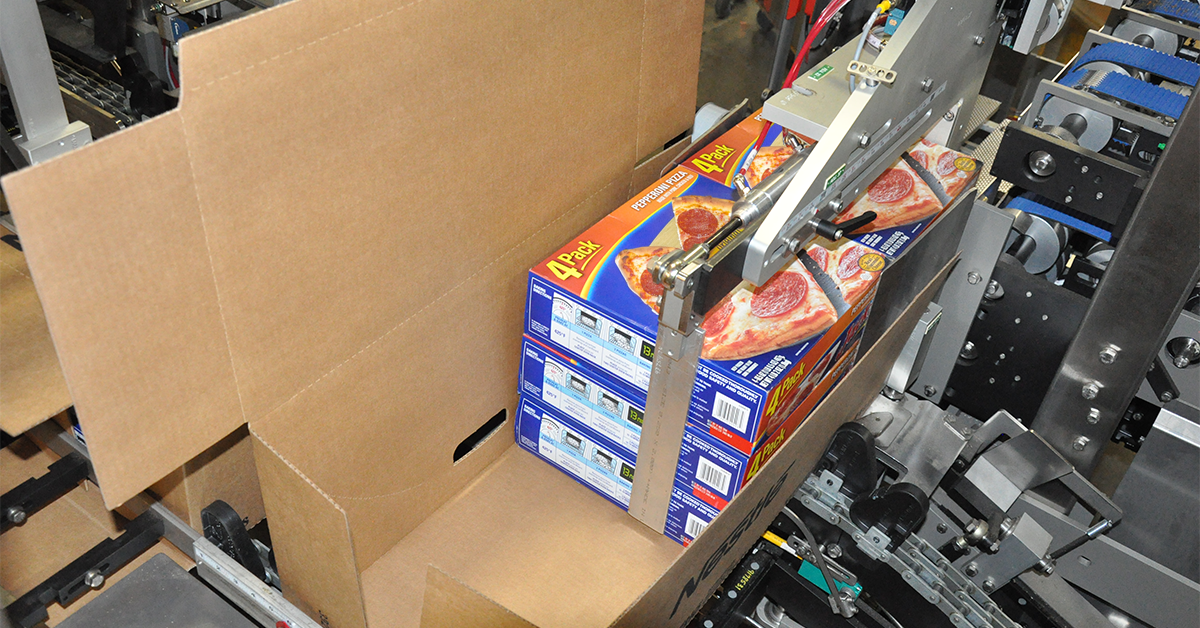
Before jumping into pricing figures, it may be helpful to clarify why you might go for a top load case packer in the first place. Simply put, top loaders are best suited for product that cannot be easily pushed (e.g. by a side load case packer), either due to primary package shape, damage potential, or the possibility of product changing shape (e.g. frozen vegetable pouches).
Beyond primary package, case type and style may be a consideration for your operation. Regular slotted cases (RSCs) are most common in top loaders, and are oriented vertically (whereas with side loaders, they are horizontal-facing). Top loaders cannot run wraparound cases, which is a common reason why operations opt for a side loader instead.
Top loaders typically operate by a pick-and-place function, where a vacuum arm (or variation) grabs product and lowers it into a case. We often see top loaders used for things like flexible pouches or pillow pack bags.
What Do I Get with My Top Load Case Packer Budget?
Top loaders in their most basic form – no case erector or sealer, no integrated modules, and only handling a single recipe at standard speeds – start at around $400,000. This baseline machine is typically capable of running around 100 products per minute (PPM).
Below this level, you can get some even simpler top load models, starting at around $300,000. But at this level, you lose some basic capabilities. These top loaders tend to have reduced flexibility and speed, and fewer SKU capabilities.
If you’re interested in robotic top load solutions, these also start around $300,000. But again, they’re a bit slower than a standard, baseline top loader. These are usually a single robot, running around 45 PPM.
Top Load Case Packer Pricing Tiers
From the basic levels, cost, complexity, and capability increase to scale. Take a look at the table below, to get an idea of what general tiers exist:
Application Type
Package Type
Speed Range (Products / Minute)
Estimated Budgetary Range
Entry-Level
• Single SKU
• Low Complexity
Package Type
Rigid or Flexible
Flat Pack
Speed Range (Products / Minute)
25–100
Estimated Budgetary Range
$300,000 – $400,000
Standard Mid-Speed
• Moderate Complexity
• Few Recipes
Package Type
Rigid or Flexible
Vertical or Flat Pack
Speed Range (Products / Minute)
100–150
Estimated Budgetary Range
$400,000 – $600,000
High-Speed
• High Complexity
• Few Recipes
Package Type
Rigid or Flexible
Vertical and/or Flat Pack
Speed Range (Products / Minute)
150+
Estimated Budgetary Range
$600,000 – $750,000+
Integrated Erect and Seal (Add-On)
Package Type
Rigid or Flexible
Vertical and/or Flat Pack
Speed Range (Products / Minute)
Any
Estimated Budgetary Range
Add $140,000 – $350,000
Full Robotic Solutions
Package Type
Rigid or Flexible
Vertical and/or Flat Pack
Speed Range (Products / Minute)
45–235 picks / minute
Estimated Budgetary Range
$325,000 – $625,000+
Note: These ballpark ranges are intended for early budgeting. Final costs are dependent on a number of factors. Speak to a vendor to get a better understanding of what a top load case packer will look like for your operation.
The biggest differences between tiers are flexibility and speed. The more SKUs you have, and the greater throughput demands, the more you’re going to have to pay for a top load case packer to meet your needs.
Pro Tip
To get the most out of this table, begin by looking at your current operation. Consider your SKU-mix and typical sustained throughput – then look at the price that matches. You’ll get a better idea of where your budgeting should start.
What Drives Up the Price of a Top Load Case Packer?
Knowing approximately where your pricing should begin, you’ll want to consider more detailed budgetary drivers. This is where the real difference can be made. The better you understand your operational nuances, the more you’ll be able to control your final costs.
1. Speed Requirements
Speed is arguably the biggest driver in overall machine cost. The faster your operation runs, the greater rigor your equipment will need to accommodate.
This accommodation usually comes through more complex configurations, advanced motion controls, and robotic cells. And more components will drive overall machine cost and complexity.
Buyer’s Tip
Align your speed requirement with your actual throughput needs – don’t just build in future-proofing for the sake of it. Identify your high-running SKUs and consider removing cost drivers that aren’t worth the capital (e.g. some low-running SKUs). Working with your vendor to identify cost-saving potential may be worth your time.
2. SKU-Mix and Changeover Needs
SKU-mix is another big cost driver. The more SKUs your top loader needs to run (and the greater the range), typically the more change parts, tooling, and adjustment points you need to manage. This makes a difference in both cost and changeover time.
If your line frequently changes recipes or pack patterns, you’ll want to take changeover into account when buying. Ask vendors how different systems deal with changeovers (e.g. speed, simplicity, potential auto adjust points).
3. Pack Orientation & Product Manipulation
One of the greatest overlooked cost drivers is product manipulation. Things like specific product orientation, dual-tier capability, or retail-readiness can make a big difference in pricing. With each of these manipulations, pricing add-ons follow – think design adjustments, component additions, and integration costs.
Buyer’s Tip
Clearly define your pack patterns early. If your goal is a specific shelf-ready design or product orientation (that is different from how they are fed), highlight that to your vendor early, so they can prepare designs ahead of time.
4. Integrated Modules: Erectors & Sealers
A common request from buyers is a fully integrated solution that forms, loads, and seals cases all in one frame. For fully automated lines, the alternative is a modular system, that spaces out these components (often connecting them through conveyance).
The trade-offs here are time, cost, and complexity. Your decision not only affects price, but also potentially floor space and line rates.
5. Customer-Specified Options
Beyond these big drivers, come smaller customer-specific add-ons. Common features here include:
- Washdown and sanitation options
- Safety certifications
- Vision systems
- Automated changeovers
This is just a short list of the many options available. But what you’ll want to prepare for now is your non-negotiables – consider productivity aids later. The more add-ons you purchase, the more you’ll move toward a custom, engineered solution.
Buyer’s Tip
Limiting these options as much as possible is a clear route to cost savings. If that’s not possible, inform vendors of additions upfront. It can save a surprising amount of time and rework later.
What Other Factors Should I Be Aware Of?
Here is a brief list of other pricing factors and considerations. Make sure to mentally flag or physically note, which of these factors are applicable for your operation:
- Adhesive
Glue vs. tape adhesives can affect overall price, due to extra components. This is especially relevant if you purchase an integrated system - Primary Pack Type
Systems are usually designed with a primary package type in mind. Systems for rigid vs. flexible vs. both types, may limit your options and affect your price. - Integrated Components
Integrating outside components (e.g. conveyors, detectors, labelers, etc.) adds complexity and increases overall cost - Machine Quality
Some machines are simply built better than others. Make sure to ask questions to help determine the quality and robustness of your build - Machine Footprint
Some vendors may charge a premium for the smallest possible footprint in an integrated system. Evaluate whether that’s needed for your operation, and if it’s not, consider a modular design instead. - Service & Support
Service agreements tend to follow machine purchases. Vendors differ not only in offerings, but also in service processes and quality.
What Do I Need to Know Before Buying?
You’re sitting at the beginning of an intimidating, but exciting process. Regardless of whether this is your first top loader or your tenth, the key is to understand and define your needs early.
To best prepare, consider the following:
- What product throughput do you actually need (think sustained)?
- How many different SKUs and pack patterns need to run through this line?
- Are there future product expansions that should be considered now?
- What’s the available floor space in your plant? Is it limited?
- How important is changeover time and operational flexibility?
- What is your overall machine efficiency target (e.g. 97-98% OEE)?
- Are you interested in exploring robotic solutions, or do you prefer linear gantry systems?
Having these needs clearly defined upfront helps avoid costly over-engineering or under-buying. It will likely also speed up your buying process, as your vendor can begin accommodations early.
Invest in What Will Pay Off in the Long Run
Pricing a top load case packer can be confusing and ambiguous because it depends on many different operational and vendor-based factors. But here’s what you know:
- Top load case packers start around $300k-$400k, and increase in price by speed and SKU-mix requirements.
- Operational specifics like product manipulations, integration level, and add-ons will impact price.
- Needs are best outlined early, and aligned with vendors sooner rather than later.
These three things – especially if you followed along with this article – will go a long way in overall preparation. And it will probably put you ahead of your competitors, if they’re buying too.
To save the most money in the long-run, try to prioritize quality and needs fulfillment over price restrictions. Investing more upfront often pays off with your machine and your vendor later.
Curious About Top Load Options?
Schedule a discovery call with Douglas. Wherever you are in the buying process, our specialists will evaluate your needs, discuss offerings, and answer your questions.