Introduction
At a Glance
A URS (User Requirements Specification) states what the buyer needs the equipment to do, and it is written by the buyer before procurement. An FDS (Functional Design Specification) states how the supplier will deliver what the URS specifies; it’s the design response to the URS. An FRS (Functional Requirements Specification) is sometimes a synonym for FDS and sometimes a distinct intermediate layer; the meaning depends on the standard your project is following.
All three feed Factory Acceptance Testing and Site Acceptance Testing. The traceability chain (URS requirement → FDS design → FAT test) is what separates a controlled project from a chaotic one.
Three letter-soup specifications URS, FDS, and FRS show up across packaging equipment procurement and validation. Their names are close, their roles overlap, and the industry doesn’t use the terms uniformly. Different companies use FRS to mean different things, and some treat URS and FDS as one document, while others rigorously separate them. This article walks through what each one captures, who writes it, when it appears, and how the three relate.
In this article, we’ll cover:
- What URS, FDS, and FRS each capture
- How they relate to FAT, SAT, and validation
- Common URS pitfalls that drive FAT failures
- How formality varies by industry
What a URS Is (and Isn’t)
A URS is a formal statement of what the buyer needs the equipment to accomplish. Written by the buyer’s engineering team before design begins, it specifies measurable, testable requirements such as line speed targets per format, changeover time, integration points with adjacent equipment, sanitary requirements, and acceptance criteria for FAT.
The critical boundary is that a URS says what, not how. If your URS says “use a 7.5-kilowatt motor,” you’ve constrained the supplier’s design freedom without necessarily improving the outcome. If it says “achieve 250 units per minute on format A,” you’ve specified a requirement the supplier can meet in multiple ways. That distinction is the line.
In regulated industries (like pharma and medical devices), the URS is mandatory and documented before procurement. In food and beverage, it may be formal, informal, or absent. Requirements might live in email chains and vendor conversations instead of a single document. The discipline matters everywhere, but the formality doesn’t always.
What an FDS Is
An FDS is the supplier’s detailed response to the URS. It’s a design specification that shows how their equipment will meet each requirement.
An FDS typically includes the sequence of operations (step-by-step execution logic for each scenario), control logic and PLC algorithms, HMI screens and operator interactions, alarm and fault-handling procedures, component specifications (motor model, sensors, and solenoids which are chosen to meet the URS targets), and the detailed FAT acceptance test plan.
The critical piece is traceability. Every design choice in the FDS should trace back to a URS requirement, and every URS requirement should have a corresponding FDS design choice and a FAT test (i.e., URS requirement → FDS design → FAT test). If your FAT plan tests something that isn’t in the URS, you’re testing beyond scope. If your URS requires something with no FAT test, you’re not actually accepting what you specified.
In regulated environments, the FDS must be reviewed and approved by the buyer’s engineering and quality teams before detailed design begins. In smaller projects, the FDS might collapse into a proposal document or data sheet without the formal label, but the underlying discipline still matters.
The FRS Terminology Gap
Here’s where the naming gets confusing. In some standards, FRS and FDS are synonyms while in others, they are distinct layers.
In GAMP 5 (the validation framework used in regulated pharma), the 2022 2nd edition consolidated URS and Functional Specification appendices into a single “Specifying Requirements” section, acknowledging that most organizations use one integrated document rather than two. In software and systems-engineering contexts, FRS describes what the system must do and a separate Design Specification describes how, which is distinct from the FDS approach where FDS includes both. The standards (ISPE GAMP, ASTM E2500, ISO 61508, IEC 61511) don’t align perfectly on terminology.
The practical reality, if you see both FRS and FDS in your project documentation, don’t panic. It’s usually a documentation convention, not a substantive difference. Ask your quality team or systems integrator which one applies. The substance—clear requirements, measurable acceptance criteria, and traceability to testing—is what matters.
How They Fit Into FAT, SAT, and Validation
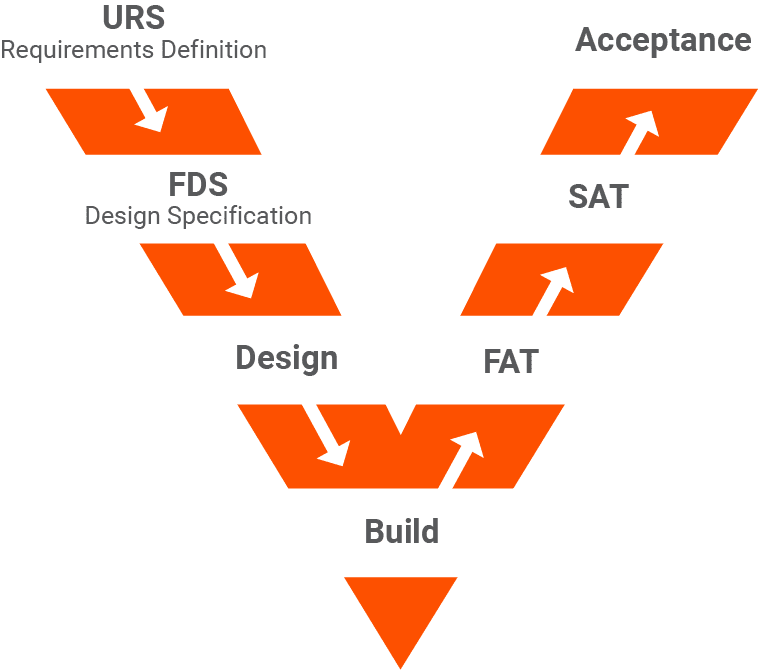
The V-model is the classical framework that ties these documents together. Picture an inverted V, where the left arm goes down from requirements to design to build, and the right arm goes up from build through testing and acceptance.
- URS (buyer’s requirements) sits at the top of the left arm
- FDS (supplier’s design response) is one layer down
- FAT (Factory Acceptance Testing) happens at the supplier’s facility before shipment, proving the equipment meets the FDS/URS (Learn more about what an FAT should and shouldn’t prove)
- SAT (Site Acceptance Testing) happens at the buyer’s site after installation, confirming the equipment performs in the buyer’s actual environment (Learn more about SATs in packaging)
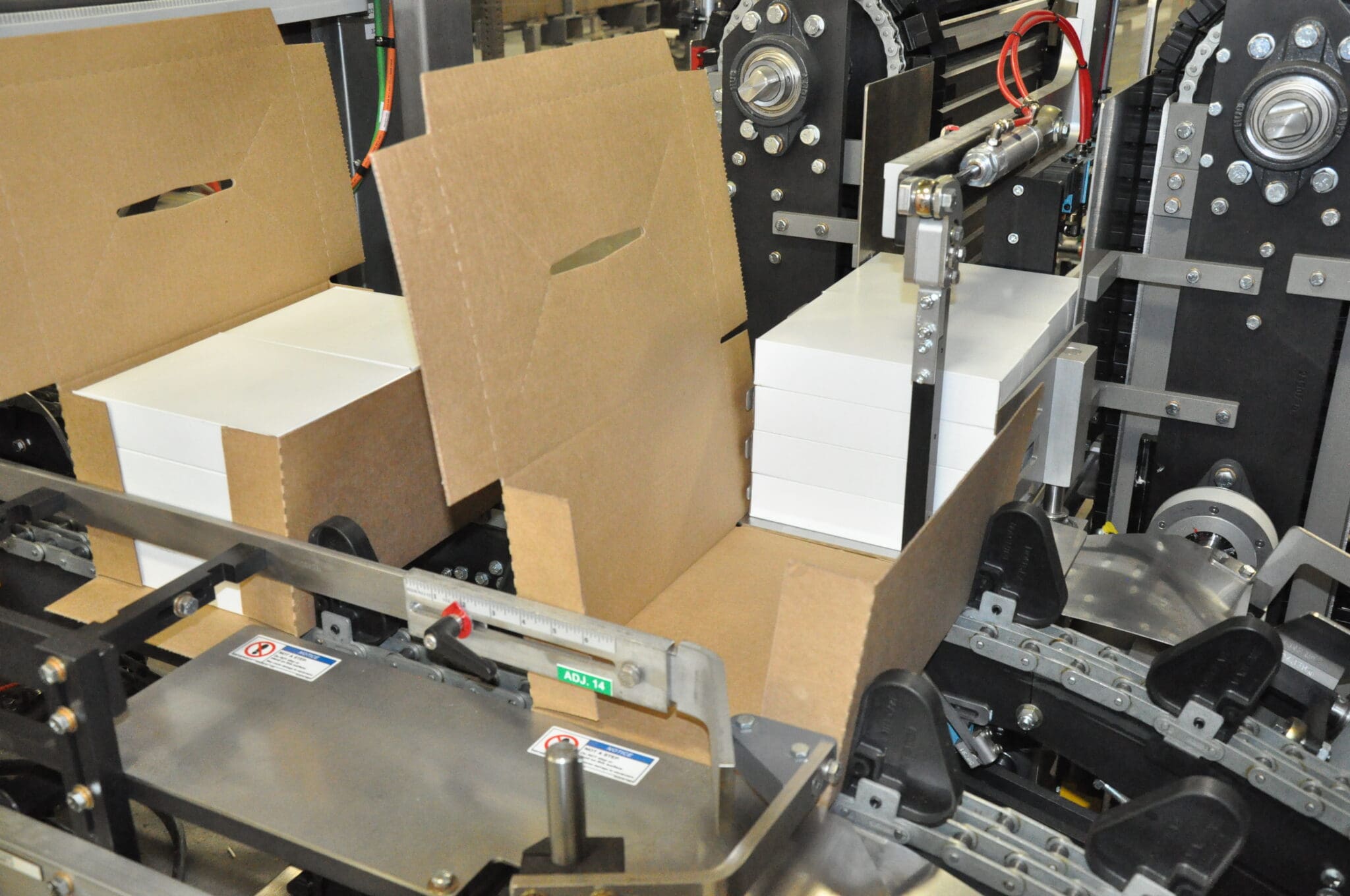
A case-packer FAT might verify 250 units per minute for one hour with no more than two product losses, format changeover from SKU A to SKU B in under 15 minutes, speed synchronization with the upstream filler, and seal strength range on 100 sealed cases.
Newer frameworks, ASTM E2500-25 (revised March 2025) and ISPE’s integrated C&Q model, relax the strict sequential V-model in favor of a flexible, risk-based approach where design and qualification activities overlap. But the underlying principle holds—requirements must trace through design through testing.
Common URS Pitfalls
Six patterns derail more URS efforts than the rest combined:
- Over-specifying solutions → This happens when specs like “use a 7.5-kW motor” are stated instead of “achieve 200 units per minute on format C.” Specify the what and let the supplier figure out the how.
- Vague acceptance criteria → “Reliable,” “user-friendly,” “good throughput” can’t be tested at FAT. Name a threshold, for example, MTBF ≥ 10,000 cycles, seal strength 4.5–5.5 N/mm, changeover ≤ 15 minutes.
- Missing operational context → The URS omits ambient conditions, available utilities, existing PLC platforms, and full SKU mix. The supplier provides guesses which are often wrong, leading to FAT surprises.
- Incomplete integration specs → Packaging lines involve multiple machines. The URS must specify every handoff—including conveyor speed sync, buffer logic, sensor protocols, and fault signals—and name which party owns each interface.
- Format-vs-speed confusion → When different SKUs run at different speeds, the URS must clearly state which target applies to which format. Otherwise FAT becomes a dispute neither side can resolve.
- Over-tight acceptance criteria → Specifying ±0.2 N/mm seal strength when your existing line runs ±0.5 N/mm with good results creates FAT failures that don’t reflect real production. Audit your own data first and specify what you actually need (vs theoretical ideals).
DO
DON’T
Pharma vs. Food/CPG: How Formality Varies
In pharmaceutical manufacturing (and increasingly in clinical nutrition, infant formula, and other pharma-adjacent food), URS and FDS are mandatory regulatory documents. EU GMP Annex 15 requires URS/FDS traceability for all equipment. The FDA has cited incomplete or missing URS/FDS documentation in warning letters. The formal frameworks (ISPE GAMP, ASTM E2500) are the standard.
In mainstream food and beverage, the picture is more varied. A large company with modern quality practices may follow a GAMP-like approach. A mid-size operation often uses a hybrid: a basic written spec (not formally called a URS, but serving the same function) plus a FAT protocol. A small producer may handle it verbally with a walk-through that serves as ad-hoc FAT. This means lower upfront effort but higher risk of misalignment.
The discipline applies in both contexts. The mental model (what does the line need to do, how will we test it, what are the measurable acceptance criteria?) matters everywhere. Many successful food companies use informal specs (a 5-page document, a few email threads, and meeting notes) that hit the key points without a formal URS label. They avoid FAT surprises because they thought through the discipline, even if they didn’t fill in a 50-page template.
What to Do Next
The core discipline is the same regardless of your industry’s formality: clear requirements, measurable acceptance criteria, and traceability from URS through FDS through testing.
If you’re about to write or review a URS, anchor it with measurable criteria, document your full production environment, and name every integration point. If you’re on the supplier side, produce an FDS that traces back to every URS requirement. If you see FRS in your documentation and aren’t sure what it means, ask your quality team. The answer usually clarifies quickly once they tell you which convention their project is following.
Need to Clarify URS, FDS, and FRS?
Give us a call. With 60+ years of experience, Douglas specialists are ready to help answer questions and guide you through decisions.