Installation & Training
Installation
Installation consists of physical placement of the machine at the Buyer’s site, reassembly, connection of services, and power-up. Customer is required to provide a licensed electrician to oversee and/or perform electrical work onsite, per laws regarding licensing requirements.
Unless otherwise specified, the Buyer will be responsible for the below items at their expense:
- Rigging of machine;
- Properly positioning equipment;
- Degrease, clean items necessary;
- Installation of necessary services sufficient for operation (e.g., water, air and power) to the location;
- At least one assigned equipment operator and maintenance technician available for instruction during installation through machine acceptance;
- Interface conveyor systems and ancillary equipment in place and functional;
- Provide a licensed electrician to oversee and/or perform electrical work per site laws and regulations.
Douglas recommends that a Douglas Service Technician assist with the machine installation and startup. Tasks to be done at this time include machine reassembling, integrating into the production line, and hand-fed testing of the first factory-tested recipe. These tasks typically take one week, dependent on machine type. A Douglas Service Technician will provide informal machine orientation and familiarization for the Buyer’s operators and maintenance personnel at the time of machine installation and startup.
See Douglas Technical Service Rates for rate and contact information.
Ramp-Up
Ramp-up consists of preliminary testing and refinement of factory-tested recipes.
Product needs to be available at the specified rates for limited runs. The machine will be changed over to all factory-tested recipes as made available by the Buyer for ramp-up, validation, and acceptance. Recipes may take one (1) to three (3) days per test. During this time, Douglas must have access to the machine to make changes as necessary. Buyer’s assigned operator and maintenance personnel should be available for operation, changeovers, and support.
If issues arise due to integration, product low, out-of-specification materials, etc., it will be the Buyer’s responsibility to resolve these issues. Delays caused by these issues will affect timelines and will be billed based on Douglas technical service rates. Any deviations from factory-tested recipes will stop the machine ramp-up process. The machine shall be accepted on factory-tested recipes prior to any additional recipes or equipment modifications that may be requested by the Buyer.
Validation
Machine validation consists of Douglas-executed test runs to validate that the machine meets defined specifications and is ready for the Buyer’s acceptance. During machine validation, the machine efficiency will be monitored by the Douglas Service Technician to determine if the specified machine efficiency is being met.
Production runs of two (2) to four (4) hours per recipe are ideal. They should include multiple changeovers intending to cover all factory-tested recipes made available by the Buyer for validation and acceptance. Buyer’s assigned operator and maintenance personnel shall be responsible for machine operation and changeovers. Douglas will be available for support and machine assessment. It may be necessary for Douglas to shut down the line intermittently to make machine adjustments. During machine validation, only factory-tested recipes will be run. Douglas will provide notice to the Buyer upon completion of the machine validation phase.
If issues arise due to integration, product flow, out-of-specification materials, etc., it will be the Buyer’s responsibility to resolve these issues. Delays caused by these issues will affect timelines and will be billed based on Douglas technical service rates. Any deviations from factory-tested recipes will stop the machine ramp-up process. The machine shall be accepted to factory-tested recipes prior to any additional recipes or equipment modifications that may be requested by the Buyer.
Acceptance
The Buyer may elect to not perform a Site Acceptance Test (SAT) if machine validation has been demonstrated. In this case, the Buyer will then sign and return the Certificate of Acceptance form found below to Douglas, unless otherwise agreed to in writing. If the Buyer determines the SAT is required, it shall be performed and completed within thirty (30) days following completion of the machine validation phase by Douglas. Failure to do so could result in additional Buyer expenses. Additional Buyer expenses may include
items such as major clean-up and generalized preventive maintenance in order to ensure the machine is still in satisfactory state prior to testing.
General
At the time of SAT, Douglas and the Buyer will assess the resources required to perform the SAT. Douglas Technical Service support, (available at Douglas technical service rates), may be required to properly monitor the SAT. Buyer may choose to run an SAT without Douglas support, however, lack of acceptance may result in Douglas services at Buyer’s expense (see SAT Results section below). External influences which may result in an adverse effect on machine operation shall not impede acceptance.
The machine shall be accepted on the recipes that were factory tested at Douglas prior to any additional recipes being run or equipment modifications being made that may be requested by the Buyer.
Prior to starting the SAT, the machine will be inspected, adjusted, etc. by the Douglas Service Technician. Douglas requires the following items to be addressed before an SAT begins:
- Material Sizes & Quality
All materials used during the SAT shall be listed in the machine specifications a factory-tested recipes fully tested at Douglas. Corrugate material should meet the voluntary standards set by the Fibre Box Association or the Packaging Machinery Manufacturer’s Institute for fiberboard boxes and blanks which run on automatic equipment.
If material is not available for the SAT within the allotted timeframe for one or more of the factory-tested recipes, the remaining factory-tested recipes will be tested. If the remaining recipes pass the SAT, the machine is eligible for acceptance. - Product Sizes & Quality
All products used during the SAT shall be as listed in the machine specification as factory-tested recipes fully tested at Douglas. Only factory-tested recipes that are available may be run during the SAT.
If product is not available for the SAT within the allotted timeframe for one or more of the factory-tested recipes, the remaining factory-tested recipes will be tested. If the remaining recipes pass the SAT, the machine is eligible for acceptance. - Consumables
Consumables include, but are not limited to, items such as glue, tape, and ink. If a Buyer-specified consumable does not meet machine intent, Douglas has the authority to stipulate that an appropriate consumable be used.
Testing
Douglas personnel will be available for support during testing. The Site Acceptance Test (SAT) consists of 8 hours of total run time over two 8-hour shifts per recipe on factory-tested recipes only. During the SAT machine speed, machine efficiency, and material yield will be measured according to the following:
Machine Speed
The machine shall meet the speeds defined in the machine specification. If the Buyer is unable to deliver product to the machine at the specified speeds, the SAT will be performed at the de-rated speeds. The SAT acceptance shall be granted off the de-rated speeds.
Technical Service Rates
Machine Efficiency
The machine shall operate with a minimum machine efficiency (identified in the specification) to be calculated as follows:

Definitions
- Total Time: Run Time + Wait Time + Stopped Time + Down Time.
- Run Time: Time the machine is running and processing product.
- Wait Time: Time the machine is in dwell due to event outside of the machine’s control; could be caused by waiting for upstream product or the downstream equipment is not ready.
- Stopped Time: Time the machine is ready, but is not running; could be caused by operator-induced cycle stop.
- Down Time: Time from a shutdown fault until the fault is cleared.
- Discounted Faults: Time associated with any faults not directly related to machine performance including faults due to nonconforming or inadequate product/materials or improper operation. This data is not identified on the HMI, but rather through review by the Douglas Service Technician and the Buyer.
During a SAT test, it is critical for the operator to allow the machine to run without intervention, unless a fault has occurred, in order to ensure accurate efficiency calculation. Accrual of ‘Stopped Time’ is the direct result of faultless intervention and will not have any details logged for further analysis.
Poor quality material or nonconforming product shall not count against the Douglas equipment. The Douglas personnel and the Buyer will determine if any machine faults or stoppages were due to the material quality. If it is determined that poor material is causing machine faults, the faults and causes shall be documented on the SAT Results Form as discounted faults and will be excluded from the final efficiency calculation.
Machine issues will be documented and eliminated by Douglas accordingly. Only major nonconformities that directly impact machine productivity will justify refusal of acceptance.
Material Yield
Saleable product must be specified by the Buyer at the time of sale and agreed to by Douglas prior to determining any material yield calculations or specified minimum material yield. In the absence of such specification, Douglas will treat the Buyer-supplied test material as the standard for saleable product.
SAT Results
Upon successful machine validation through SAT, the Buyer will sign and return the Certificate of Acceptance form (found below) to Douglas. Unless otherwise agreed in writing, any unpaid portion of the purchase price will be due and payable immediately after the Certificate of Acceptance has been signed; or, if the SAT is not carried out and/or completed for reasons for which Douglas is not responsible, the unpaid portion of the purchase price will be due within 90 days of machine shipment.
After machine acceptance, Douglas Technical Service will remain available to respond to warranty and service requests.
If the Buyer’s personnel are unable to run the machine at the efficiency defined in the specification, Douglas personnel will be given the opportunity to demonstrate that the machine will run at specified efficiency per test criteria defined above. If Douglas personnel demonstrate that the machine will meet the efficiency requirements, the Buyer will be billed Douglas technical service rates in effect at the time of demonstration for these personnel.
Documentation
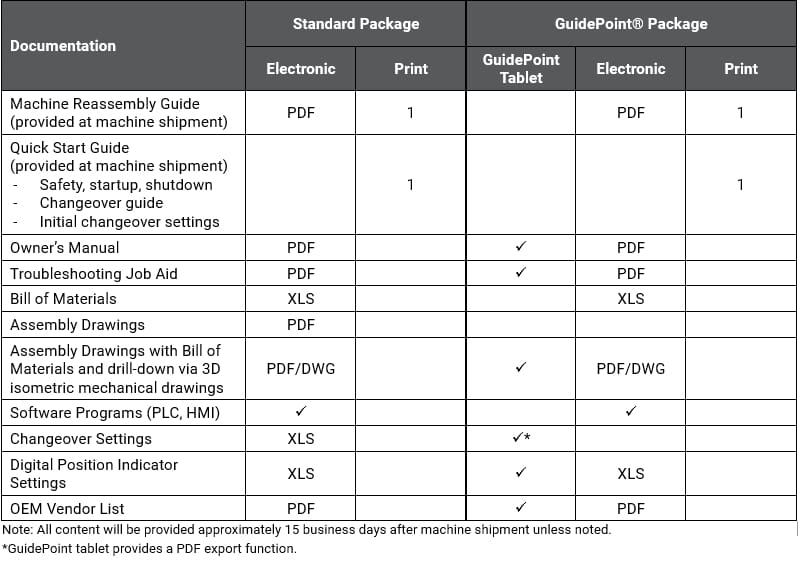
Douglas’ technical publications provide informative, easy-to-understand operator and maintenance machine documentation. Included is either the Standard Package OR the GuidePoint® Package if the GuidePoint tablet option is selected, not both.
Risk Assessment
Douglas has committed itself to providing its buyers with the highest quality machines in the area of safety through design. As a result of our comprehensive efforts to improve the quality as well as the safety of our machines, our risk assessments have become much more descriptive of our designs and therefore are considered to be the intellectual property of Douglas Machine, Inc.
The risk assessment now contains descriptions of areas that are proprietary to Douglas and must remain that way. Because of this, Douglas risk assessment documents shall not be duplicated, copied, reproduced or distributed in any manner outside of Douglas, nor shall these documents leave the premises of Douglas Machine, Inc.
This document should be reviewed as part of the design reviews between our two companies or per request at the Douglas facility.
Technical Training
Douglas’ Technical Machine Training provides high levels of training to strengthen techical skills of the Buyer’s staff and to streamline the performance of the Buyer’s staff and machine.
With a well-trained staff, satisfied with knowing how to do their job well, the Buyer’s organization will benefit from increased performance and maintain its competitive edge. Contact Douglas for details and pricing.
Available Training Programs
Introductory Hands-On Training
- Start-up & Shutdown
- Machine Changeover
Formal Training (Operation & Maintenance)
- Classroom Learning with Hands-On Application
- Training Guides
- Multimedia Presentation
- Job Aids (optional)
Douglas Training Center
- Structured Classroom Learning with Hands-On Application at Douglas Training Center
- Course Materials
- Machine Platform-Based