Introduction
At a Glance
Equipment degradation sends signals weeks or months before failure. Preventive maintenance (PM) works on a schedule (every 5,000 hours, every 24 months) regardless of condition. Predictive maintenance (PdM) monitors condition data and acts only when failure is imminent.
For high-cost, line-critical assets (like palletizers, large drives, and servo systems), PdM prevents 30-50% more downtime than PM. For commodity equipment, the cost of sensors and integration usually exceeds the value. Choose PdM if failure stops your line and the asset is expensive. If failure is inconvenient and the asset is cheap, stay on PM or accept run-to-failure.
In this article, we’ll cover:
- What PM and PdM do differently
- The P-F curve and why PdM works
- The technology stack that catches failures early
- Which assets justify the PdM investment
- What PdM requires beyond sensors
Preventive Maintenance: The Calendar Approach
Preventive maintenance (PM) is schedule-based work performed at predetermined intervals, regardless of equipment condition. For example, change the oil every 5,000 hours and replace the bearing seal every 24 months. The logic behind this approach is that components wear predictably, and a controlled replacement during a planned window costs less than an unplanned failure.
The Society for Maintenance & Reliability Professionals (SMRP) reports that organizations with effective PM achieve 15–30% reduction in unplanned downtime versus run-to-failure operations.
However, PM has its trade-offs. Reliability research attributes about 68% of equipment failures to maintenance activity itself. Over-maintenance (replacing parts before they need it) can introduce new failure risk while under-maintenance misses failures that arrive faster than the scheduled upkeep. PM is based on statistical averages and cannot predict which specific machine on your line will fail.
Predictive Maintenance: The Condition Approach
Predictive maintenance (PdM) responds to the immediate condition of the equipment.
Instead of replacing parts based on a calendar, PdM monitors equipment health during normal operation, taking into account factors such as vibration, temperature, oil chemistry, and electrical current. The logic behind this approach is that equipment degradation always follows a detectable path before failure. If you monitor the right signal, you can catch the warning weeks or months before the machine fails.
The P-F Curve
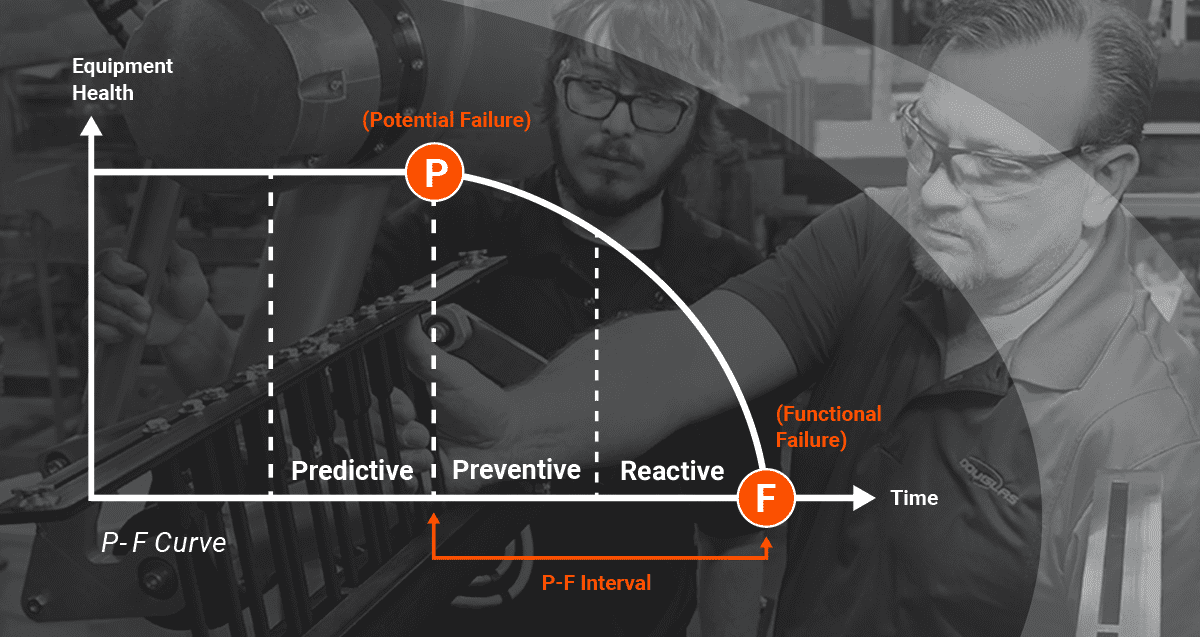
The effectiveness of PdM can be explained with something called the P-F curve (see illustration below). This graph depicts the window of time between the moment when the machine’s symptoms first appear (Potential Failure or P) and the moment when the asset stops performing (Functional Failure or F).
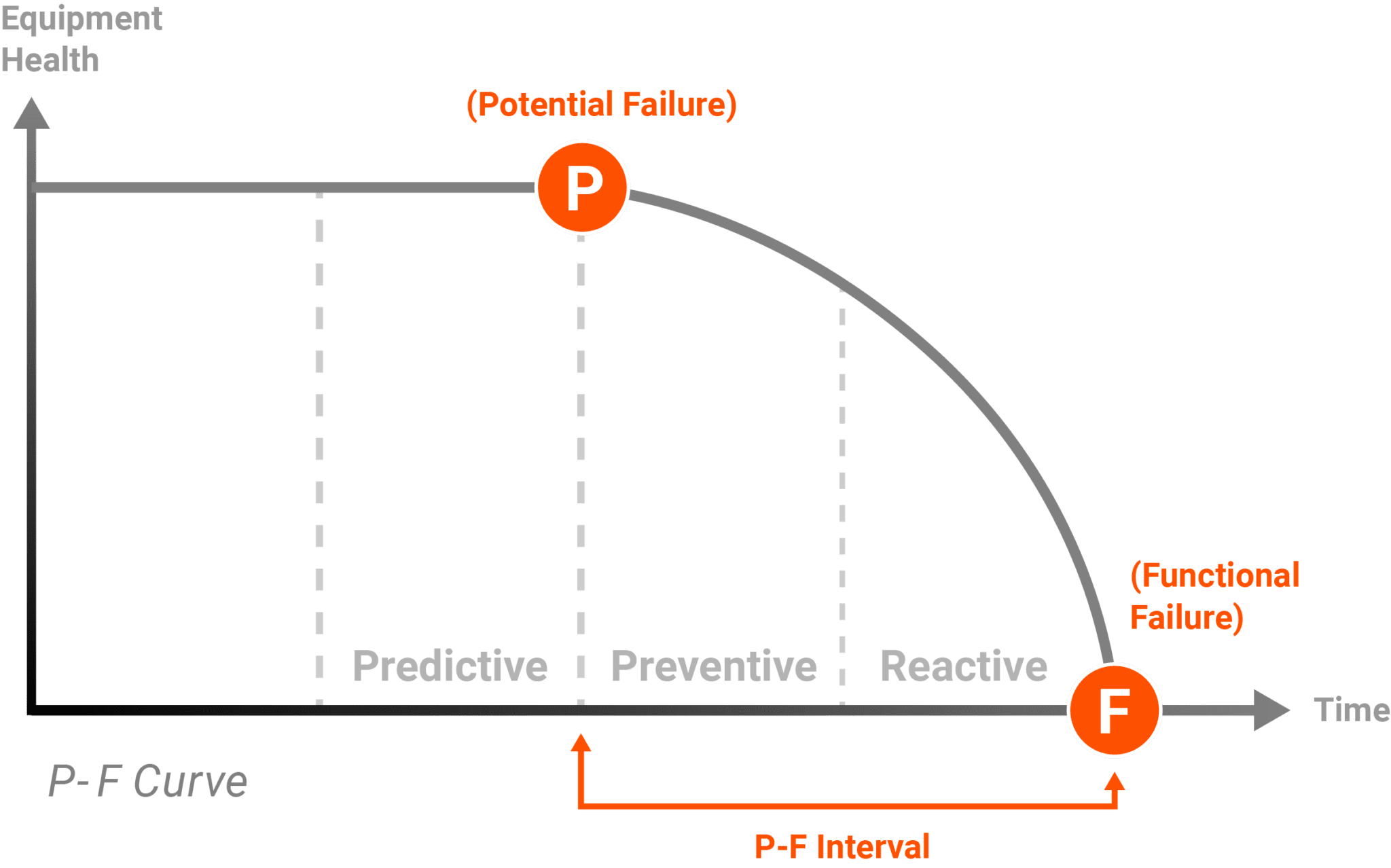
- P (Potential Failure) → When the machine’s symptoms first appear, signaling that degradation is underway (e.g., a bearing’s vibration spikes or a motor’s temperature creeps upward)
- F (Functional Failure) → The asset stops performing (e.g., a bearing seizes or the motor stops)
- P-F Interval → The time between P and F (your action window)
The action window varies by failure mode. A bearing issue might give you three weeks while insulation degradation might give you six months. Of course, the earlier you detect P, the wider your window becomes, which means your maintenance response is planned vs reactive. This strategic and proactive approach is why PdM prevents 30–50% more unplanned downtime than PM.
The Technology Stack
PdM is a toolkit of complementary technologies, each catching specific failure modes:
Technology
What It Catches
Best For
Vibration analysis
Autopopulated Value (Mobile Only)
Bearing wear, imbalance, looseness, friction
Autopopulated Value (Mobile Only)
Rotating equipment (motors, pumps, gear drives)
Oil and lubricant analysis
Autopopulated Value (Mobile Only)
Internal wear (metals), viscosity changes, contamination
Autopopulated Value (Mobile Only)
Gearboxes, hydraulics, large motors
Motor Current Signature Analysis (MCSA)
Autopopulated Value (Mobile Only)
Cracked rotor bars, worn bearings, shaft eccentricity, insulation breakdown
Autopopulated Value (Mobile Only)
Alternating-current (AC) induction motors (no shutdown required)
Infrared thermography
Autopopulated Value (Mobile Only)
Hot spots, electrical resistance, friction, insulation failure
Autopopulated Value (Mobile Only)
Electrical, mechanical, hydraulic systems
Ultrasound
Autopopulated Value (Mobile Only)
High-frequency sounds (20-100 kHz) from friction, bearings, faulty electrical
Autopopulated Value (Mobile Only)
Bearings, valves, electrical equipment
These technologies can be used jointly vs separately. For example, vibration plus MCSA, plus oil analysis together detect about 94% of developing faults, versus roughly 60% with vibration alone.
Pro Tip
MCSA detects faults 60–120 days before vibration analysis even hints at a problem. Most aftermarket operations don’t deploy it, however, on packaging lines running large palletizers or conveyor motors, it’s a non-invasive early-warning system worth pricing in.
Which Assets Deserve Predictive Maintenance?
Not every asset on your line requires PdM.
When used on cheap assets, PdM infrastructure—such as sensors, integration with a computerized maintenance management system (CMMS), and analyst skills—often costs more than the downtime it prevents. A $50K monitoring program on a $15K conveyor is a loss, whereas a $100K PdM investment on a $1M palletizer pays for itself in three days of prevented downtime.
Use PdM on High-Cost, Line-Critical Assets
Use PM (or Run-to-Failure) on Commodity Equipment
Many programs fail because they falsely assume that sensors are all that’s needed for PdM. In reality, sensors are only the visible 20–30% of a PdM program. The other 70—80% consists of hidden elements and their costs are worth calculating.
That hidden majority includes:
- CMMS Integration: Sensor alerts must flow into work orders automatically. Without this, PdM is an expensive dashboard whose alerts get ignored.
- Baseline Data: Equipment must run normally for 1–4 weeks before sensors can establish what “normal” looks like.
- Analyst Skills: Someone has to interpret the data. This could be trained in-house technicians (6–12 month learning curve), a hired specialist ($80K–$120K+), or an outsourced PdM service ($100–$300 per asset per month).
- Culture Shift: PM is task-driven (e.g., “Oil change scheduled on Thursday”). PdM is data-driven (e.g., “Vibration on bearing 2 has risen 30% and must be replaced next week”). Plan for 6–12 months of adoption.
A single-asset PdM pilot takes 3–6 months to stand up. A line of 10 critical machines takes 6–12 months. For equipment built before 2010, retrofit sensors are often expensive and mechanically invasive and, therefore, return-on-investment (ROI) math may favor staying on PM.
Where PdM Sits in the Maintenance Landscape
PdM is one option on a spectrum. Other options include the following:
- Reactive (run until it breaks) → Cheap on the balance sheet, but expensive when catastrophic failures hit
- Preventive (calendar-based) → Industry standard and cost-effective for most assets
- Predictive (condition-based) → Target for high-value assets
- Prescriptive (predictive + automated recommendations on what to do and when) → This emerging model requires mature CMMS
- Reliability-Centered Maintenance (RCM) (strategic framework that picks a unique maintenance strategy per failure mode) → Worth knowing about but rarely the right starting point
For most aftermarket operations (e.g., a single site with 10–20 critical machines and constrained staffing), a practical target is a combination of both PdM and well-designed PM. Many high-performing plants run successfully without RCM.
Conclusion
To summarize, PM and PdM coexist in mature packaging operations. High-cost, high-criticality assets such as palletizers, large drives, servo systems, and cartoners are the types of equipment that deserve condition monitoring. Commodity equipment stays on PM or run-to-failure because, for that type of equipment, the costs of PdM would outweigh the savings.
The real investment in PdM isn’t the sensors; it’s CMMS integration, baselines, analyst skills, and culture change taking place over a span of 3–12 months. The P-F curve is based on the principle that degradation is always detectable before failure, and is the reason why PdM works.
If you’re evaluating PdM, try asking these three questions to help you narrow the path:
- What are your highest-cost, most-critical assets?
- What’s the P-F interval for the failure modes that cost you the most in unplanned downtime?
- Does a 3–6 month stand-up timeline and a culture shift toward data-driven maintenance fit your bandwidth?
Not Sure Which Type of Maintenance is Right for You?
If you’re considering maintenance options, give us a call. With 60+ years of experience, Douglas specialists are ready to help guide you to the best solutions.